


The best free business listing sites in the USA start with Google Business Profile, Bing Places, Yelp, Apple Business Connect, Facebook and the Better Business Bureau. After those, add data providers such as Data Axle and Foursquare, general directories such as Yellow Pages and Manta, and industry directories that match what you sell. This guide covers 100 business directories, shows which are free and which are paid, and tells you the order to claim them in.
Last reviewed: October 2026. We rechecked the list and removed directories that have closed or no longer accept business listings.
Claim the core platforms first (Google, Bing, Yelp, Apple, Facebook, LinkedIn, BBB), keep your name, address and phone number identical everywhere, then work down through data providers, general directories and industry-specific sites. Most listings have a free option, and paid upgrades are optional.
Top 10 Business Listing Sites in the USA (Quick List)
If you only have an afternoon, claim these ten in this order:
- Google Business Profile: controls how you appear in Google Search and Maps. Free.
- Bing Places for Business: feeds Bing and Microsoft products. Free.
- Yelp for Business: high-trust reviews. Free listing, paid ads optional.
- Apple Business Connect: controls your Apple Maps listing. Free.
- Facebook Business Page: doubles as a listing and social proof. Free.
- LinkedIn Company Page: essential for B2B brands. Free.
- Better Business Bureau: trust signal. Basic profile is free, accreditation is paid.
- Nextdoor Business Page: hyperlocal reach. Free.
- Foursquare: location data that feeds many apps. Free.
- Yellow Pages: the best-known general directory. Free basic listing.
⚡ Key Takeaways
- Consistent NAP data (name, address, phone) across every directory is the most important citation factor.
- Start with Google Business Profile, Bing, Yelp and Apple before niche sites.
- Free listings are enough for most small businesses. Paid upgrades rarely help early on.
- Industry directories such as Avvo, Zocdoc and Houzz often send better-qualified traffic than general ones.
- Duplicate listings hurt local SEO, so search before you create anything.
- Audit your listings at least twice a year and update them within days of any change.
Why Free Business Listing Directories in the USA Still Matter in 2026
If you run a local business, directory listings are one of the most cost-effective ways to build visibility, earn citations and support your local rankings. Directories act as trust signals for search engines, lead sources for customers and the data that AI search tools and map apps draw on.
BrightLocal’s Local Consumer Review Survey reports that 98% of consumers used the internet to find information about local businesses in 2022. Citation signals, which include directory listings, are one group of local ranking factors that local SEO specialists track in Whitespark’s annual Local Search Ranking Factors study. Listings help most when they sit alongside a strong Google Business Profile, reviews and a good website.
Step 1: Prepare Your Business Information Before You Submit Anything
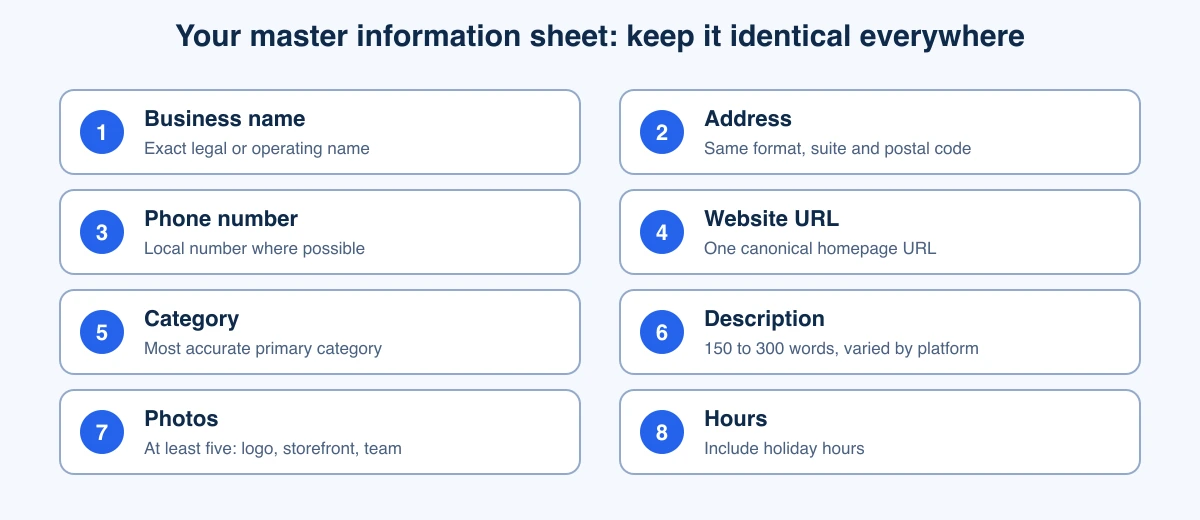
Before you submit a single listing, build one master information sheet. Inconsistent data is one of the most common reasons businesses fail to see results from directory work. If your phone number appears in three different formats, search engines have to guess which is right.
- Business name: your exact legal or operating name, with no keyword stuffing.
- Address: the full street address, including suite number, in the same format every time.
- Phone number: one primary number, formatted consistently, for example (555) 555-5555.
- Website URL: one canonical homepage URL, used consistently.
- Business hours: include holiday hours where the platform allows.
- Categories: two or three accurate categories. Most directories allow a primary and secondary.
- Description: a 150 to 200 word version and a longer 500-word version, because character limits differ.
- Logo and photos: a logo of at least 400 x 400 pixels and five to ten business photos.
- Social profile URLs: some directories let you link them.
💡 Pro Tip: Store your details in one shared sheet with the login for every directory. Every person who touches your listings should copy from that single source. One mistyped phone number repeated across 30 directories can take months to clean up.
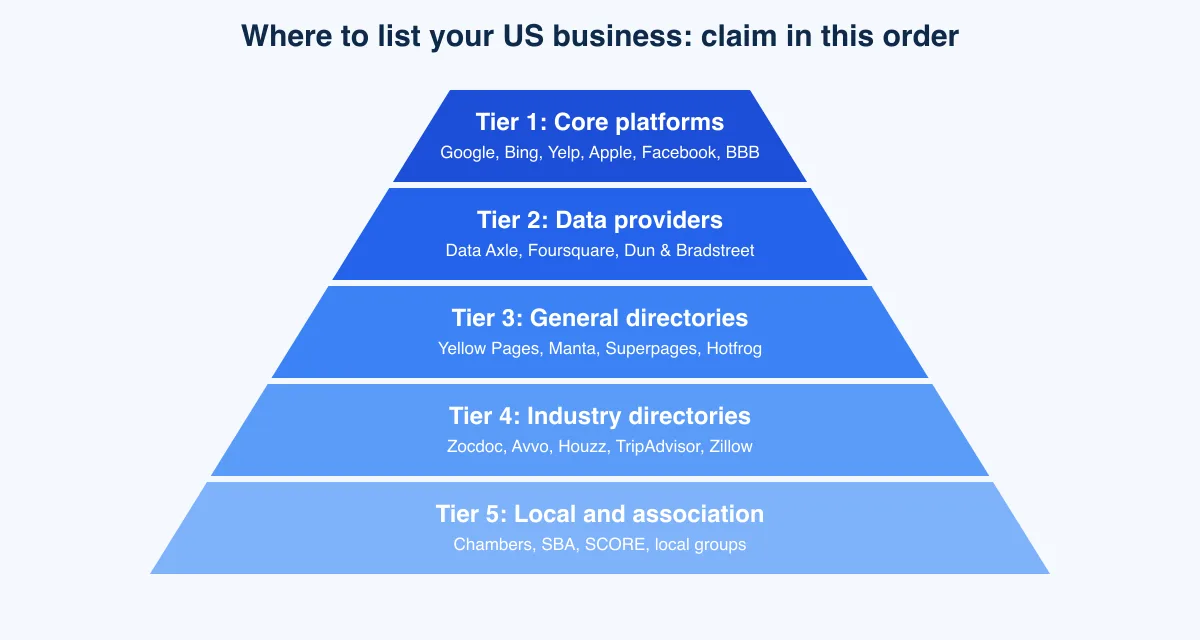
Step 2: Understand the Tiers of Directory Authority
Not all directories are equal. Some are crawled constantly and carry real authority. Others are thin sites that add little. Sorting them into tiers tells you where to spend your time.
| Tier | Examples | Value | Priority |
|---|---|---|---|
| Tier 1: Core platforms | Google Business Profile, Bing Places, Yelp, Apple, Facebook, BBB | Very high | Do immediately |
| Tier 2: Data providers | Data Axle, Foursquare, Dun & Bradstreet | High, feeds other sites | First week |
| Tier 3: General directories | Yellow Pages, Manta, Superpages, Hotfrog, Brownbook | Moderate | First month |
| Tier 4: Industry directories | Zocdoc, Avvo, Houzz, Tripadvisor, Zillow | High for the right vertical | First month |
| Tier 5: Local and association | Chambers of commerce, SCORE, SBA, local groups | Moderate to high (hyper-local) | Ongoing |
Data providers deserve special attention. Records held by providers such as Data Axle and Foursquare are reused by other directories and apps, so an accurate record there can improve data across the web. For wider visibility, our guide on building local pages that win in AI-powered search shows how listings connect to AI search.
Step 3: The Top 100 Business Listing Directories in the USA
Below is the master list by category. Most have a free option, and some also sell paid upgrades or leads. Stick to the free tier unless you have a clear reason to pay. Pricing changes, so confirm current terms on each site before you sign up.
Core Platforms (Must-Do First)
- Google Business Profile (business.google.com): Controls how you appear in Google Search and Maps. Claim, verify and fill in every field. [Free]
- Bing Places for Business (bingplaces.com): Feeds Bing and Microsoft products. You can import your Google listing. [Free]
- Yelp for Business (business.yelp.com): High-trust reviews platform. Claiming is free, advertising is optional. [Free + paid ads]
- Apple Business Connect (business.apple.com): Controls how you appear in Apple Maps and across Apple apps. [Free]
- Facebook Business Page (facebook.com/business): Works as both a listing and social proof. [Free]
- LinkedIn Company Page (linkedin.com/company): Essential for B2B brands and employer visibility. [Free]
- Nextdoor Business Page (business.nextdoor.com): Hyperlocal reach through neighborhood recommendations. [Free + paid ads]
- Better Business Bureau (bbb.org): A well-known trust signal. A basic profile is free, accreditation is paid. [Free basic + paid accreditation]
Data Providers and Distribution
- Data Axle (data-axle.com): Business data provider whose records feed many directories. [Varies]
- Foursquare (foursquare.com): Location data used by many apps and map services. [Free]
- Dun & Bradstreet (dnb.com): Free D-U-N-S number used for business credit files and vendor onboarding. [Free D-U-N-S + paid products]
- Yext (yext.com): Pushes your details to many directories at once. A paid shortcut, not a requirement. [Paid]
General Business Directories
- Yellow Pages (yellowpages.com): The best-known US directory. Free basic listing, paid upgrades. [Free basic + paid]
- Superpages (superpages.com): Long-running directory tied to the Yellow Pages family. [Varies]
- Manta (manta.com): Small business directory with company profiles. [Free basic + paid]
- Hotfrog (hotfrog.com): Free business listings with optional paid upgrades. [Free + paid]
- MerchantCircle (merchantcircle.com): Local merchant network with profiles and offers. [Varies]
- Brownbook (brownbook.net): Free listing directory with global reach. [Free + paid]
- Chamber of Commerce (chamberofcommerce.com) (chamberofcommerce.com): General small business directory. [Varies]
- Insider Pages (insiderpages.com): Local recommendations and business profiles. [Varies]
- Cylex USA (cylex-usa.com): Business directory with local listings. [Varies]
- 2FindLocal (2findlocal.com): Local business directory. [Varies]
- EZlocal (ezlocal.com): Local business directory. [Varies]
- ThreeBestRated (threebestrated.com): Curated lists of local businesses by city and category. [Varies]
- ProvenExpert (provenexpert.com): Profile and review platform for service providers. [Varies]
Review and Rating Platforms
- Trustpilot (trustpilot.com): Customer review platform widely trusted by shoppers. [Free basic + paid plans]
- Sitejabber (sitejabber.com): Consumer reviews, especially for online businesses. [Varies]
- ConsumerAffairs (consumeraffairs.com): Consumer review site covering many industries. [Varies]
- Angi (angi.com): Home services marketplace with reviews. [Free profile + paid leads]
- Thumbtack (thumbtack.com): Local services marketplace. Profile is free, you pay for leads. [Free profile + paid leads]
- Porch (porch.com): Home services profiles and reviews. [Varies]
- Expertise.com (expertise.com): Editorial rankings of local service providers. [Varies]
- BuildZoom (buildzoom.com): Contractor profiles and licensing data. [Varies]
- Houzz (houzz.com): Home design and renovation professionals. [Free + paid]
- Networx (networx.com): Home services quotes and contractor profiles. [Varies]
B2B, Startup and Agency Directories
- Alignable (alignable.com): Small business networking and referrals. [Free + paid]
- Crunchbase (crunchbase.com): Company profiles for startups and tech businesses. [Free profile]
- Wellfound (wellfound.com): Startup profiles and hiring (formerly AngelList Talent). [Free profile]
- Product Hunt (producthunt.com): Launch platform for digital products. [Free]
- Clutch (clutch.co): B2B agency and service-provider reviews. [Free profile + paid]
- GoodFirms (goodfirms.co): Reviews and listings for IT and agency firms. [Varies]
- G2 (g2.com): Software and service reviews for B2B buyers. [Free profile + paid]
- Capterra (capterra.com): Software directory and reviews. [Free listing + paid]
- Kompass (kompass.com): B2B supplier and exporter directory. [Free basic + paid]
- ThomasNet (thomasnet.com): Industrial supplier and manufacturer directory. [Varies]
- DesignRush (designrush.com): Agency directory and rankings. [Varies]
- The Manifest (themanifest.com): Business news and agency directory. [Varies]
Employer and Company Data
- Glassdoor (glassdoor.com): Employer profile and reviews. [Free profile]
- Indeed Company Pages (indeed.com): Employer branding on a major job site. [Free profile]
- ZoomInfo (zoominfo.com): Business contact database. Companies can claim profiles. [Varies]
- Owler (owler.com): Company profiles and competitor tracking. [Free profile]
- OpenCorporates (opencorporates.com): Open database of company registrations. [Free (data source)]
Map and Navigation Platforms
- Waze (waze.com): Navigation app with local business listings and ads. [Free + paid ads]
- MapQuest (mapquest.com): Long-running maps and directions service. [Varies]
- OpenStreetMap (openstreetmap.org): Open map data. Anyone can add or correct a place. [Free]
Social and Community Platforms
- Instagram Business (instagram.com): Business profile with contact buttons and location. [Free]
- Pinterest Business (business.pinterest.com): Business profile that drives visual search traffic. [Free]
- X (Twitter) Business Profile (x.com): Business profile and brand handle. [Free]
- YouTube Channel (youtube.com): Channel with business information and a website link. [Free]
Government, Chamber and Association Directories
- U.S. Chamber of Commerce (uschamber.com): National business association. [Membership varies]
- Local Chamber of Commerce (your city’s chamber site): Local membership directory. Often one of the strongest local links. [Membership fee]
- SCORE (score.org): Free mentoring network for small businesses. [Free]
- NFIB (nfib.com): Small business association. [Membership fee]
- SBA Dynamic Small Business Search (dsbs.sba.gov): Searchable federal database of small businesses. [Free]
- SAM.gov (sam.gov): Registration required to sell to the federal government. [Free]
Healthcare Directories
- Zocdoc (zocdoc.com): Appointment booking for healthcare providers. [Paid]
- Healthgrades (healthgrades.com): Provider profiles and patient reviews. [Free basic + paid]
- Vitals (vitals.com): Doctor profiles and patient reviews. [Free basic + paid]
- RateMDs (ratemds.com): Doctor ratings and profiles. [Free basic + paid]
- Psychology Today (psychologytoday.com): Therapist and counselor directory. [Paid]
Legal Directories
- Avvo (avvo.com): Lawyer profiles and ratings. [Free profile + paid]
- FindLaw (findlaw.com): Lawyer directory and legal information. [Paid]
- Martindale-Hubbell (martindale.com): Lawyer directory and peer ratings. [Free basic + paid]
- Justia (justia.com): Lawyer directory and legal information. [Free basic + paid]
- Lawyers.com (lawyers.com): Lawyer directory. [Varies]
- Super Lawyers (superlawyers.com): Peer-reviewed attorney listings. [Selection based]
- Nolo (nolo.com): Legal information with a lawyer directory. [Paid]
Automotive Directories
- DealerRater (dealerrater.com): Dealer reviews. [Varies]
- Cars.com (cars.com): Dealer listings and reviews. [Paid for dealers]
- CarGurus (cargurus.com): Dealer listings and reviews. [Paid for dealers]
- Edmunds (edmunds.com): Dealer listings and reviews. [Paid for dealers]
Hospitality, Food and Events
- Tripadvisor (tripadvisor.com): Hotels, restaurants and attractions. [Free to claim + paid]
- OpenTable (opentable.com): Restaurant reservations and reviews. [Paid]
- Eventbrite (eventbrite.com): Event listings and ticketing. [Free + fees]
- Meetup (meetup.com): Groups and events for local communities. [Paid for organizers]
- Groupon Merchant (merchant.groupon.com): Local deals and offers for businesses. [Revenue share]
Real Estate Directories
- Zillow (zillow.com): Agent and brokerage profiles. [Free profile + paid]
- Realtor.com (realtor.com): Agent and brokerage profiles. [Paid]
- Trulia (trulia.com): Agent profiles. [Varies]
- Redfin (redfin.com): Partner agent listings. [Varies]
Weddings, Beauty, Care and Home
- WeddingWire (weddingwire.com): Wedding vendor directory. [Free profile + paid]
- The Knot (theknot.com): Wedding vendor directory. [Free profile + paid]
- StyleSeat (styleseat.com): Booking platform for beauty and salon professionals. [Free + paid]
- Vagaro (vagaro.com): Booking platform for salons, spas and fitness. [Paid subscription]
- Fresha (fresha.com): Booking platform for salons and spas. [Free + fees]
- Booksy (booksy.com): Booking platform for beauty and wellness. [Paid subscription]
- Care.com (care.com): Child, senior and pet care providers. [Free + paid]
- Rover (rover.com): Pet care providers. [Free + fees]
- HomeGuide (homeguide.com): Home services cost guides and contractor listings. [Varies]
- TaskRabbit (taskrabbit.com): Local task and handyman marketplace. [Free + fees]
All 100 Business Directories in the USA at a Glance
| # | Directory | Type | Pricing |
|---|---|---|---|
| 1 | Google Business Profile | Core platform | Free |
| 2 | Bing Places for Business | Core platform | Free |
| 3 | Yelp for Business | Core platform | Free + paid ads |
| 4 | Apple Business Connect | Core platform | Free |
| 5 | Facebook Business Page | Core platform | Free |
| 6 | LinkedIn Company Page | Core platform | Free |
| 7 | Nextdoor Business Page | Core platform | Free + paid ads |
| 8 | Better Business Bureau | Core platform | Free basic + paid accreditation |
| 9 | Data Axle | Data provider | Varies |
| 10 | Foursquare | Data provider | Free |
| 11 | Dun & Bradstreet | Data provider | Free D-U-N-S + paid products |
| 12 | Yext | Data provider | Paid |
| 13 | Yellow Pages | General directory | Free basic + paid |
| 14 | Superpages | General directory | Varies |
| 15 | Manta | General directory | Free basic + paid |
| 16 | Hotfrog | General directory | Free + paid |
| 17 | MerchantCircle | General directory | Varies |
| 18 | Brownbook | General directory | Free + paid |
| 19 | Chamber of Commerce (chamberofcommerce.com) | General directory | Varies |
| 20 | Insider Pages | General directory | Varies |
| 21 | Cylex USA | General directory | Varies |
| 22 | 2FindLocal | General directory | Varies |
| 23 | EZlocal | General directory | Varies |
| 24 | ThreeBestRated | General directory | Varies |
| 25 | ProvenExpert | General directory | Varies |
| 26 | Trustpilot | Reviews | Free basic + paid plans |
| 27 | Sitejabber | Reviews | Varies |
| 28 | ConsumerAffairs | Reviews | Varies |
| 29 | Angi | Reviews | Free profile + paid leads |
| 30 | Thumbtack | Reviews | Free profile + paid leads |
| 31 | Porch | Reviews | Varies |
| 32 | Expertise.com | Reviews | Varies |
| 33 | BuildZoom | Reviews | Varies |
| 34 | Houzz | Reviews | Free + paid |
| 35 | Networx | Reviews | Varies |
| 36 | Alignable | B2B / professional | Free + paid |
| 37 | Crunchbase | B2B / professional | Free profile |
| 38 | Wellfound | B2B / professional | Free profile |
| 39 | Product Hunt | B2B / professional | Free |
| 40 | Clutch | B2B / professional | Free profile + paid |
| 41 | GoodFirms | B2B / professional | Varies |
| 42 | G2 | B2B / professional | Free profile + paid |
| 43 | Capterra | B2B / professional | Free listing + paid |
| 44 | Kompass | B2B / professional | Free basic + paid |
| 45 | ThomasNet | B2B / professional | Varies |
| 46 | DesignRush | B2B / professional | Varies |
| 47 | The Manifest | B2B / professional | Varies |
| 48 | Glassdoor | Employer / company data | Free profile |
| 49 | Indeed Company Pages | Employer / company data | Free profile |
| 50 | ZoomInfo | Employer / company data | Varies |
| 51 | Owler | Employer / company data | Free profile |
| 52 | OpenCorporates | Employer / company data | Free (data source) |
| 53 | Waze | Maps | Free + paid ads |
| 54 | MapQuest | Maps | Varies |
| 55 | OpenStreetMap | Maps | Free |
| 56 | Instagram Business | Social | Free |
| 57 | Pinterest Business | Social | Free |
| 58 | X (Twitter) Business Profile | Social | Free |
| 59 | YouTube Channel | Social | Free |
| 60 | U.S. Chamber of Commerce | Association / government | Membership varies |
| 61 | Local Chamber of Commerce | Association / government | Membership fee |
| 62 | SCORE | Association / government | Free |
| 63 | NFIB | Association / government | Membership fee |
| 64 | SBA Dynamic Small Business Search | Association / government | Free |
| 65 | SAM.gov | Association / government | Free |
| 66 | Zocdoc | Healthcare | Paid |
| 67 | Healthgrades | Healthcare | Free basic + paid |
| 68 | Vitals | Healthcare | Free basic + paid |
| 69 | RateMDs | Healthcare | Free basic + paid |
| 70 | Psychology Today | Healthcare | Paid |
| 71 | Avvo | Legal | Free profile + paid |
| 72 | FindLaw | Legal | Paid |
| 73 | Martindale-Hubbell | Legal | Free basic + paid |
| 74 | Justia | Legal | Free basic + paid |
| 75 | Lawyers.com | Legal | Varies |
| 76 | Super Lawyers | Legal | Selection based |
| 77 | Nolo | Legal | Paid |
| 78 | DealerRater | Automotive | Varies |
| 79 | Cars.com | Automotive | Paid for dealers |
| 80 | CarGurus | Automotive | Paid for dealers |
| 81 | Edmunds | Automotive | Paid for dealers |
| 82 | Tripadvisor | Hospitality / events | Free to claim + paid |
| 83 | OpenTable | Hospitality / events | Paid |
| 84 | Eventbrite | Hospitality / events | Free + fees |
| 85 | Meetup | Hospitality / events | Paid for organizers |
| 86 | Groupon Merchant | Hospitality / events | Revenue share |
| 87 | Zillow | Real estate | Free profile + paid |
| 88 | Realtor.com | Real estate | Paid |
| 89 | Trulia | Real estate | Varies |
| 90 | Redfin | Real estate | Varies |
| 91 | WeddingWire | Weddings / beauty / care / home | Free profile + paid |
| 92 | The Knot | Weddings / beauty / care / home | Free profile + paid |
| 93 | StyleSeat | Weddings / beauty / care / home | Free + paid |
| 94 | Vagaro | Weddings / beauty / care / home | Paid subscription |
| 95 | Fresha | Weddings / beauty / care / home | Free + fees |
| 96 | Booksy | Weddings / beauty / care / home | Paid subscription |
| 97 | Care.com | Weddings / beauty / care / home | Free + paid |
| 98 | Rover | Weddings / beauty / care / home | Free + fees |
| 99 | HomeGuide | Weddings / beauty / care / home | Varies |
| 100 | TaskRabbit | Weddings / beauty / care / home | Free + fees |
Step 4: How to Submit Your Listing Correctly
How you complete each profile decides whether the directory sends you traffic and whether search engines treat the citation as trustworthy. Follow this process for every listing:
- Search for an existing listing first. Look up your business name and phone number before creating anything. Claiming an existing listing beats creating a duplicate.
- Complete every field. Fill in hours, payment methods, service areas and any optional fields. Complete profiles perform better.
- Write a unique description for each platform. Use genuinely helpful wording, not keyword stuffing, and avoid pasting the same text everywhere.
- Upload photos. Listings with real photos get more engagement. Do not skip this step.
- Verify your listing. Most directories verify by phone, email or postcard. Unverified listings may not appear.
- Link to a relevant page. Where the directory allows it, link to the most relevant service page rather than only the homepage.
💡 Pro Tip: Add UTM parameters to your directory links, for example ?utm_source=yelp&utm_medium=directory&utm_campaign=local-citations. Then Google Analytics shows exactly which directories send visitors who convert.
Step 5: Maintain and Audit Your Listings Consistently
Listing is a one-time effort, but keeping listings accurate is ongoing. Businesses move, phone numbers change and hours shift. Every uncorrected inconsistency is a small SEO liability.
- Monthly: check for new reviews on Google, Yelp and BBB, and respond to every one.
- Quarterly: run a citation audit with a tool such as BrightLocal, Whitespark or Moz Local to find outdated, duplicate or missing data.
- Annually: review your categories on every platform as your services change.
- Immediately: update listings within 48 hours of any change to your phone number, address or hours.
Review handling is part of the same job. If it takes too much time, professional online reputation management services can monitor and respond for you. Our guide to common Google Business Profile mistakes also applies to most other platforms.
Step 6: Leverage Directories as Part of a Broader Local SEO Strategy
Directory listings work best as one part of a coordinated local SEO effort. Here is how to connect them to the rest of your marketing.
Citations and On-Page SEO
Your website should repeat the same name, address and phone number that appear in directories. Put the address in the footer, add LocalBusiness structured data, and make sure the homepage title and description reflect your location.
Link Building Connections
Some directories give followed links and many do not, and a directory link on its own rarely moves rankings. Treat directory links as a base for your citation profile, not as a link-building strategy. To go further, read how to build backlinks in competitive and low-competition niches.
Content and Local Pages
Create city or neighborhood landing pages and link to them from directory profiles where allowed. Our guide to local AEO best practices for small businesses covers how to structure them.
Social Signals
Facebook, LinkedIn and Nextdoor double as directories and social platforms. Keep them active with posts and offers. For a full view of which social platforms deserve attention, see the top 100 social media sites guide.
💡 Pro Tip: Do not list and forget. Google Business Profile, Yelp and Nextdoor reward active profiles, so post updates, add photos and answer reviews regularly.
Step 7: Avoid These Common Directory Listing Mistakes
Duplicate Listings
Two listings for the same business on one directory split your reviews and confuse search engines. Search first, and merge or remove duplicates before creating anything new.
Inconsistent NAP Data
Even small differences such as “St.” and “Street” matter. Pick one format and use it everywhere.
Choosing the Wrong Categories
Generic categories such as “Business” or “Services” do little. Choose the most specific category available, for example “HVAC Contractor” rather than “Home Services”.
Thin or Copied Descriptions
Pasting the same short blurb into dozens of directories adds little value. Write different descriptions that mention your services and location naturally.
Ignoring Industry Directories
Many businesses stop at Google and Yelp. A profile on Houzz for a renovation company or Avvo for a law firm can send much more targeted traffic.
Not Tracking Performance
Without UTM parameters or a check of your referral traffic, you cannot tell which directories are worth maintaining.
These mistakes do more damage together. A business with 80 inconsistent, duplicate listings is often worse off than one with 20 accurate, verified profiles. If you manage SEO for a small business with limited time, SEO services for small businesses can build and maintain a clean citation profile for you.
Practical Action Plan: Where to Start Right Now
Work through these in order. Colour shows how urgent each group is.
High priorityWeek 1
- Claim and fully complete Google Business Profile, Bing Places, Apple Business Connect and Yelp. Verify each one and upload photos.
- Check Data Axle, Foursquare and Dun & Bradstreet so the data other directories reuse is accurate.
Medium priorityFirst month
- Work through the general directories (Tier 3) and the industry directories (Tier 4) that fit your business. Thirty minutes a day gets five to ten listings done at a time.
- Run a citation audit with BrightLocal or Whitespark to find existing listings, duplicates and inaccuracies.
Low priorityLater
- Small or new directories with little traffic. Add them eventually for breadth, but never ahead of maintaining your main listings.
- Paid upgrades. The free listing usually delivers the value you need. Consider paid options only where competitors in your market use them heavily, such as Yelp or Angi.
If you want to go beyond manual listing work, structured local SEO packages combine citation building, on-page work and review generation.
Frequently Asked Questions
What are the best free business listing sites in the USA?
The best free options are Google Business Profile, Bing Places, Apple Business Connect, Facebook, LinkedIn, Foursquare and a free basic listing on Yelp, Yellow Pages and Manta. Industry directories such as Healthgrades and Avvo also offer free basic profiles.
How many business directories should I submit to?
Quality and accuracy matter more than quantity. Start with the top 20 to 30 directories, make those profiles complete and verified, then expand gradually. A few dozen accurate listings beat a hundred inconsistent ones.
Do free directory listings help SEO?
Directory citations are one of several local ranking signals tracked in studies such as Whitespark’s Local Search Ranking Factors. They help most when your name, address and phone number are consistent and they sit alongside a strong Google Business Profile, reviews and a good website. They also bring referral traffic and social proof.
How long does it take to see results from directory submissions?
Most verified listings are indexed within a few weeks. Ranking movement from citation work typically takes several months, depending on competition and how consistent your data is. Google Business Profile verification can take up to a couple of weeks by postcard.
What happens if I have duplicate listings on a directory?
Duplicates split your reviews and confuse search engines about which details are correct. Claim the listing with the best data, mark the other as a duplicate or closed if the platform allows it, and ask the directory’s support team to remove the incorrect one.
Are paid directory upgrades worth it for small businesses?
For most small businesses the free tier gives most of the benefit. Paid upgrades mainly buy featured placement or leads, not stronger citation signals. Test one platform, such as Yelp or Angi in a competitive service niche, before paying on several.
Which directories are best for a specific industry?
Choose directories your customers already use. Examples include Zocdoc and Healthgrades for healthcare, Avvo and FindLaw for legal, Houzz and Angi for home services, Tripadvisor and OpenTable for hospitality, and Zillow for real estate.
Conclusion: Business Directories Are a Long-Term Local SEO Asset
Building a presence across the right business directories in the USA is not a one-afternoon task. It is a long-term asset that grows in value as your listings become more consistent, complete and trusted. Businesses that keep their listings accurate tend to outperform those that submit once and forget.
Start with the core platforms, move through the data providers, then expand into general and industry directories. Pair that with a well-optimized website, steady review responses and strong local content.
If you want expert help building and managing your listings as part of a full local SEO plan, explore our local SEO services.
Sources: BrightLocal Local Consumer Review Survey, Whitespark Local Search Ranking Factors. Directory details and pricing were checked in October 2026 and can change.


