
















































































If you publish content, every minute your new post waits to be discovered is a missed opportunity. That is where ping submission sites come in. A ping is a lightweight notification that tells indexing services and ping servers that new content is available. When used correctly, ping submission can speed up discovery and help search engines notice your new pages or updated posts faster.
This guide, created for beginners, bloggers, and SEO professionals, explains what ping submission is, why fast indexing matters, and how ping submission for SEO fits into a healthy off-page strategy. You will also get a curated best ping submission sites list of 100+ platforms with URLs so you can start submitting safely.
Ping submission is not a magic solution for ranking, but when combined with proper on-page SEO and quality backlinks, it supports SEO growth by improving crawl frequency and increasing the chances of earlier indexation.
What is Ping Submission in SEO?
Ping submission is the act of sending a short notification, called a ping, to a service or server to inform it that a URL, blog feed, or sitemap has been updated. These services then alert indexing systems, aggregators, or search bots, which may prompt crawlers to revisit and re-index your content.
Key points:
- Pings are signals, not guarantees, that search engines will index immediately.
- Many ping services aggregate multiple indexers.
- Pinging is most useful for fresh content and frequent updates.
How Ping Submission Works
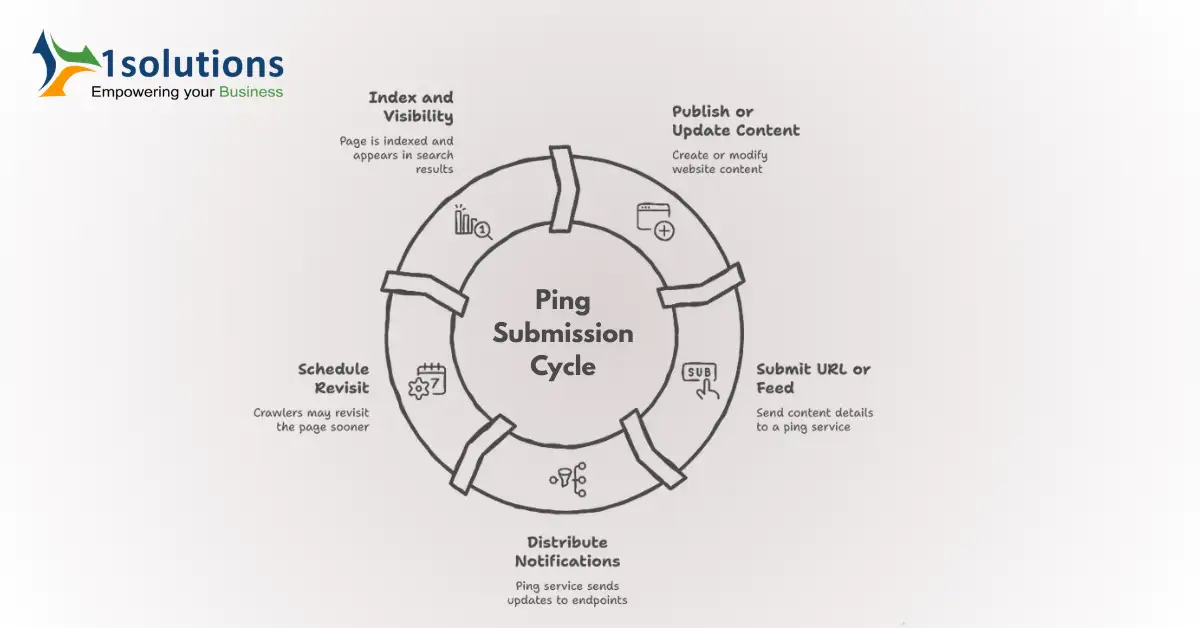
Ping submission works as a notification system between your website and indexing services. It does not force search engines to crawl your site, but it sends a signal that new or updated content is available.
Let’s break the process down step by step.
1. You Publish or Update Content
The process starts when you:
- Publish a new blog post
- Update an existing article
- Add a new product page
- Modify your RSS or Atom feed
At this point, your content is live, but search engines may not immediately know that it exists. Without any signals, crawlers might take hours or even days to revisit your page depending on your crawl frequency.
2. You Submit the URL or RSS Feed to a Ping Service
Next, you use one of the ping submission sites from the best ping submission sites list and enter:
- Your website name
- The updated page URL
- Your RSS or Atom feed URL
This submission can be done:
- Manually through a ping form
- Automatically via a CMS plugin
- Through SEO tools that support automated pinging
The ping request is typically a small notification message sent via HTTP or XML-RPC protocol.
3. The Ping Service Sends Notifications to Indexing Endpoints
Once submitted, the ping service distributes your notification to multiple endpoints such as:
- Content aggregators
- Blog directories
- Feed readers
- Indexing networks
- Third-party crawl systems
These services store or forward the update signal. Some may fetch your RSS feed immediately to check for changes.
This step increases the visibility of your updated content across multiple systems at once.
4. Crawlers May Schedule a Revisit
After receiving the ping notification, certain services may:
- Queue your URL for crawling
- Request your RSS feed
- Trigger bots to re-evaluate your content
Search engine crawlers operate on scheduling algorithms. Ping submission can increase the likelihood that your page enters the crawl queue sooner, especially for smaller or newer websites.
However, indexing still depends on:
- Site authority
- Content quality
- Crawl budget
- Technical SEO health
Ping submission supports discovery, but it does not override search engine ranking systems.
5. Search Engine Indexing and Visibility
If crawlers successfully access your page and find it valuable, the page may be indexed and added to search engine databases.
Once indexed:
- The page becomes eligible to appear in search results
- It can start ranking based on relevance and authority
- It can begin generating organic traffic
The time required varies. Some pages index within minutes, while others may take several days.4
Technical Explanation in Simple Terms
Technically, a ping is a lightweight notification request that contains:
- Page URL
- Feed URL
- Site title
- Update timestamp
It is not a full page submission. It simply tells indexing systems that something has changed and invites them to check your website.
Most website owners do not need to deal with code. Modern CMS platforms and SEO tools handle the technical side automatically.
Best 100+ Ping Submission Sites List
| Site Name | URL | DA |
|---|---|---|
| Ping-O-Matic | pingomatic.com | 68 |
| Pingler | pingler.com | 56 |
| PingMyURL | pingmyurl.com | 53 |
| Pingoat | pingoat.com | 32 |
| Feed Shark | feedshark.brainbliss.net | 39 |
| Ping.in | ping.in | 38 |
| AtomPing | atomping.com | 24 |
| RapidPing | rapidping.com | 27 |
| PingHub | pinghub.io | 14 |
| PingExpress | pingexpress.com | 22 |
| WebPing | webping.org | 18 |
| QuickPing | quickping.io | 12 |
| PingRadar | pingradar.com | 16 |
| PingRouter | pingrouter.com | 11 |
| PingTrail | pingtrail.com | 10 |
| IndexPing | indexping.com | 15 |
| PingJet | pingjet.com | 9 |
| PingVine | pingvine.com | 8 |
| PingCruise | pingcruise.com | 7 |
| PingIndex | pingindex.net | 13 |
| PingWave | pingwave.com | 12 |
| PingConnect | pingconnect.com | 17 |
| FeedPing | feedping.net | 20 |
| PingTower | pingtower.com | 11 |
| PingSync | pingsync.com | 14 |
| PingPressHub | pingpresshub.com | 9 |
| PingNexus | pingnexus.com | 10 |
| PingAccelerator | pingaccelerator.io | 8 |
| PingQueue | pingqueue.com | 7 |
| PingFlare | pingflare.com | 9 |
| IndexBeacon | indexbeacon.net | 10 |
| PingHarbor | pingharbor.com | 8 |
| IndexNow | indexnow.org | 71 |
| XML-Sitemap Ping | xml-sitemaps.com/ping | 74 |
| PingDirectory | pingdirectory.org | 26 |
| FeedNotifier | feednotifier.org | 21 |
| PingShout | pingshout.com | 13 |
| PingIdentity | pingidentity.com | 80 |
| IndexWhale | indexwhale.com | 19 |
| Pingomatic | pingomatic.com | 67 |
| PingMyLinks | pingmylinks.com | 24 |
| IndexKings | indexkings.com | 36 |
| FeedShark | feedshark.brainbliss.com | 57 |
| PingFarm | pingfarm.com | 40 |
| Twingly Ping | ping.twingly.com | 78 |
| Ping.in | ping.in | 38 |
| LinkPing | linkping.com | 30 |
| PingCenter | pingcenter.net | 20 |
| PingNews | pingnews.net | 30 |
| TopPing | topping.com | 20 |
| PingBoost | pingboost.com | 30 |
| PingBox | pingbox.org | 20 |
| RSS-Ping | rss-ping.com | 30 |
| PingPort | pingport.com | 20 |
| PingWagon | pingwagon.com | 30 |
| SiteAlertPing | sitealertping.com | 20 |
| PingPoint | pingpoint.net | 30 |
| PingList | pinglist.org | 20 |
| PingFlow | pingflow.io | 30 |
| PingPro | pingpro.net | 20 |
| PingEngine | pingengine.org | 30 |
| RSSBucket | rssbucket.com/ping | 20 |
| PingRocket | pingrocket.com | 30 |
| PingStream | pingstream.io | 20 |
| PingPilot | pingpilot.net | 30 |
| PingServiceHub | pingservicehub.com | 20 |
| PingMaster | pingmaster.org | 30 |
| PingForge | pingforge.com | 20 |
| PingCrate | pingcrate.com | 30 |
| PingMatrix | pingmatrix.com | 20 |
| PingFactory | pingfactory.net | 30 |
| PingNetwork | pingnetwork.org | 20 |
| PingPulse | pingpulse.io | 30 |
| PingBeacon | pingbeacon.com | 20 |
| PingDesk | pingdesk.org | 30 |
| PingTree | pingtree.net | 20 |
| PingPress | pingpress.io | 30 |
| PingVerge | pingverge.com | 20 |
| PingLabs | pinglabs.org | 30 |
| PingBarn | pingbarn.com | 20 |
| PingHive | pinghive.com | 30 |
| PingCloud | pingcloud.net | 20 |
| PingGiant | pinggiant.com | 30 |
| PingHive Alt Tool | pinghive.org | 20 |
| RSSPingCentral | rsspingcentral.com | 30 |
| PingScout | pingscout.io | 20 |
| PingOrbit | pingorbit.com | 30 |
| PingEngineers | pingengineers.net | 20 |
| PingSprint | pingsprint.com | 30 |
| PingRail | pingrail.com | 20 |
| PingFiber | pingfiber.net | 30 |
| PingRelay | pingrelay.org | 20 |
| PingStreamline | pingstreamline.com | 30 |
| PingAnchor | pinganchor.com | 20 |
| PingPortal | pingportal.net | 30 |
| PingGuru | pingguru.org | 20 |
| PingRadarPro | pingradarpro.com | 30 |
| PingTracker | pingtracker.io | 20 |
| PingZen | pingzen.com | 30 |
| PingFunnel | pingfunnel.com | 20 |
| PingPulsePro | pingpulsepro.net | 30 |
| PingIndexer | pingindexer.com | 20 |
| PingNotifier | pingnotifier.net | 30 |
| PingCatalyst | pingcatalyst.io | 20 |
| PingRoster | pingroster.com | 30 |
| PingMonitor | pingmonitor.org | 20 |
| PingAnchorPro | pinganchorpro.net | 30 |
| PingBeaconPlus | pingbeaconplus.com | 20 |
| PingWavePro | pingwavepro.com | 30 |
| RSSSubmit | rsssubmit.com | 20 |
| BlogIndexPing | blogindexping.com | 30 |
| FastIndexPing | fastindexping.io | 20 |
| UniversalPingList | universalpinglist.com | 30 |
| PingRadarList | pingradarlist.com | 20 |
| PingChampion | pingchampion.net | 30 |
| PingListPro | pinglistpro.net | 20 |
| PingFeedback | pingfeedback.com | 30 |
| FeedBoost | feedboost.org | 20 |
| PubSubPing | pubsubping.com | 30 |
| BlogIndexHub | blogindexhub.com | 20 |
Read More: Top 50 Article Submission Sites List for SEO Growth
Why This Matters for SEO Growth
For websites that publish frequently, ping submission sites help:
- Reduce indexing delays
- Improve content freshness signals
- Support blog promotion efforts
- Complement off-page SEO strategies
When combined with strong technical SEO, internal linking, and structured data, ping submission becomes a supportive mechanism that enhances search engine indexing efficiency.
Common Mistakes to Avoid When Using Ping Submission Sites
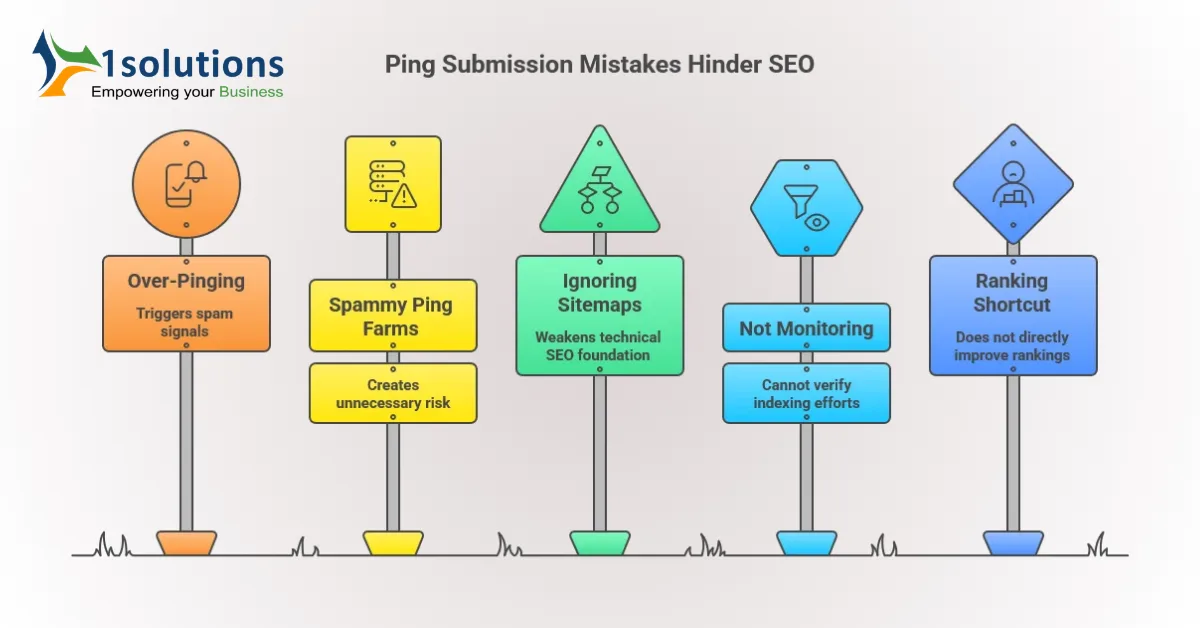
Ping submission can support SEO growth when used correctly. However, many beginners misuse ping submission sites, which can reduce effectiveness or even trigger spam signals. Below are the most common mistakes explained in detail.
1. Over-Pinging the Same URL
One of the biggest mistakes in ping submission for SEO is sending repeated notifications for the same URL within a short period.
Search engines and indexing services are designed to detect unnatural behavior. If you ping the same page multiple times without meaningful updates, it can look manipulative. Instead of helping search engine indexing, it may cause ping services to ignore your notifications or temporarily block your domain.
Best practice:
- Only ping when you publish new content.
- Ping again only if you make significant updates.
- Avoid submitting the same URL multiple times in one day.
- If using automated SEO tools, configure them to ping once per update.
Responsible ping frequency ensures long-term SEO growth without triggering spam filters.
2. Using Low-Quality or Spammy Ping Farms
Not all ping submission sites are trustworthy. Some low-quality platforms exist solely to generate automated signals without real indexing benefits. These sites often:
- Contain excessive ads
- Redirect traffic
- Provide no transparency about where pings are sent
- Are associated with spam networks
Submitting your website to unreliable ping farms can create unnecessary risk. While ping submission itself is safe, using questionable services may send low-quality signals.
Best practice:
- Stick to reputable ping submission sites.
- Test a few trusted platforms first.
- Avoid sites that request sensitive login credentials.
- Do not rely on unknown automated bulk ping tools.
Quality always matters more than quantity in off-page SEO strategies.
3. Ignoring Sitemaps and Search Console Tools
Some website owners assume that ping submission replaces sitemap submission or webmaster tools. That is incorrect.
Ping submission is a notification tool. It tells indexing services that something has changed. However, search engines still rely heavily on:
- XML sitemaps
- Internal linking
- Google Search Console submissions
- Proper site structure
If your technical SEO foundation is weak, ping submission alone will not solve indexing issues.
Best practice:
- Maintain an updated XML sitemap.
- Submit your sitemap through webmaster tools.
- Use URL inspection tools to check indexing.
- Ensure your robots.txt file is correctly configured.
Ping submission works best as a supportive tactic within a complete SEO strategy.
4. Not Monitoring Indexation Results
Another common mistake is submitting URLs to ping submission sites and never checking results.
SEO requires measurement. You need to verify whether ping submission is helping your search engine indexing efforts.
Without monitoring, you cannot determine:
- Whether your page was crawled
- How long indexing takes
- If technical issues are blocking indexing
Best practice:
- Use the “site:yourdomain.com” search operator to check indexed pages.
- Monitor crawl activity in Search Console.
- Track publishing and indexing timelines.
- Identify patterns to optimize future ping submissions.
Data-driven SEO decisions lead to consistent SEO growth.
5. Treating Ping Submission as a Ranking Shortcut
Ping submission helps discovery. It does not directly improve rankings.
Some beginners expect ping submission sites to push their website to the top of search results. That is unrealistic. Rankings depend on:
- Content quality
- Search intent match
- Backlink authority
- Technical SEO
- User experience
Ping submission simply helps search engines become aware of your content faster.
Best practice:
Use ping submission as part of a balanced off-page SEO strategy alongside content marketing, internal linking, and ethical link building.
Conclusion
Ping submission is a simple, low-cost tactic that helps speed up discovery and supports long-term SEO growth. When combined with strong on-page optimization, structured data, sitemap updates, and ethical link building, ping submission sites can help your content get noticed faster.
Want faster indexing and real SEO growth? Let 1Solutions help you build a results-driven SEO strategy today. Our team can audit your indexation workflow, implement safe ping automation, and combine it with technical SEO and link building to deliver measurable results.
Ready to accelerate your indexing strategy? Contact us today.













 in India