













































































Search engine optimisation has evolved dramatically over the last decade. Artificial intelligence, machine learning, and user behavior modeling now influence how search engines interpret relevance and authority.
The discussion is no longer about whether backlinks work. Instead, it focuses on how they work, when they matter most, and how they should be acquired in a modern SEO environment.
Backlink & SEO Statistics
Pages with backlinks perform markedly better
- Top-ranking pages typically have 3.8× more backlinks than pages in lower positions, showing the strong correlation between backlinks and search visibility.
- Only around 6% of all web pages ever earn even one external backlink, meaning the majority of content never receives organic endorsements.
- Approximately 95% of web pages have zero backlinks, making authority signals rare and highly valuable.
Backlinks correlate with traffic outcomes
- Websites with 40+ referring domains receive 7.6× more organic traffic than sites with fewer than 10 referring domains.
- Pages with backlinks are 3.8× more likely to earn organic traffic than pages without them.
Quality matters more than quantity
- Backlinks from high-authority domains have 5.2× more impact on rankings than links from low-authority sites.
- Roughly 37% of backlinks point beyond homepages, indicating the importance of a diversified link profile.
- Medium- or high-risk backlinks account for about 30% of all links, highlighting the need for ongoing quality control.
Backlink behaviour and industry perspective
- Around 65% of marketers consider link building one of the most challenging SEO tactics due to the effort and expertise required.
- SEO professionals report that it can take 2-6 weeks for a backlink to begin influencing rankings.
Backlinks remain a critical ranking signal, but their value depends on context, relevance, intent, and trust.
In 2026, backlinks are best understood as credibility indicators rather than mechanical ranking shortcuts. Search engines use them to confirm expertise, validate content quality, and assess brand authority.
When integrated into a broader SEO strategy, backlinks continue to deliver measurable performance gains.
Backlinks in 2026 must be understood within the context of modern search engine behavior, evolving evaluation criteria, and their relationship with content quality, local SEO, and ethical acquisition practices that align with current search engine expectations.
What Are Backlinks?
Backlinks are hyperlinks from one website to another. From the earliest days of Google, they served as a core ranking signal. The logic was simple: if reputable websites link to a page, that page is likely valuable.
While this principle still holds true, the way search engines interpret backlinks has changed significantly.
Backlinks in 2026 are analyzed through advanced contextual and semantic frameworks. Algorithms evaluate not just the existence of a link, but the intent behind it, the relevance of surrounding content, and the historical trustworthiness of the linking domain.
A single backlink from a respected, topically aligned publication can outperform dozens of links from unrelated or low-authority sources. This shift reflects a broader trend in SEO: quality, relevance, and user value now outweigh scale.
Evolution of Search Engine Algorithms
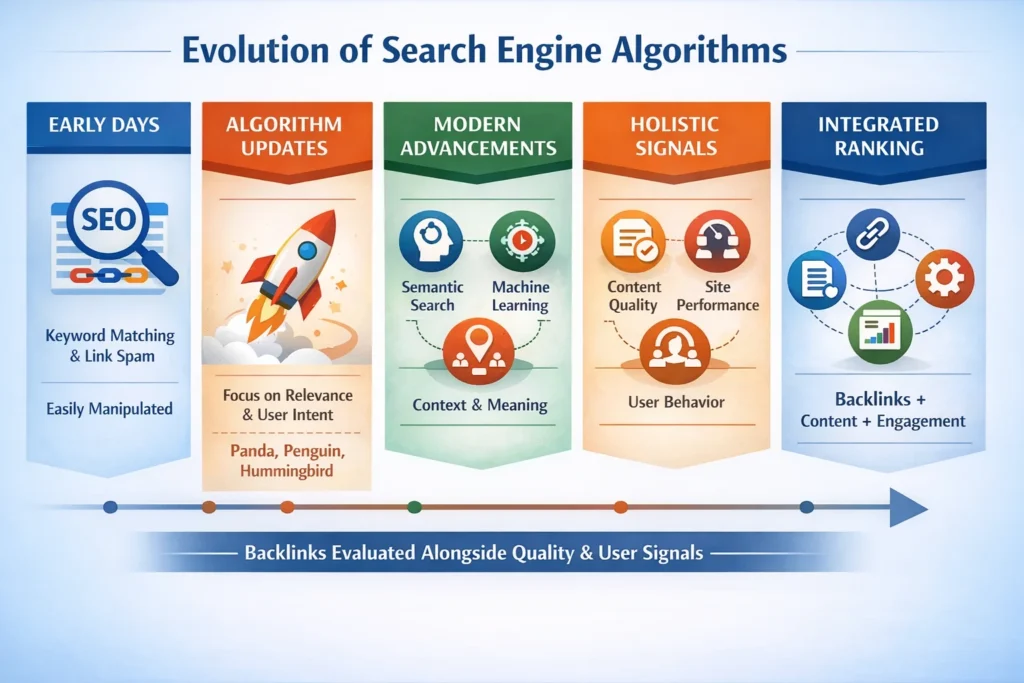
Understanding backlinks today requires an appreciation of how search algorithms have evolved.
Early search engines relied heavily on keyword matching and link volume. This approach was vulnerable to manipulation, leading to widespread abuse.
Over time, search engines introduced algorithm updates designed to reward relevance, intent, and user satisfaction.
Key developments include semantic search, machine learning-based ranking systems, and entity recognition. These advancements allow search engines to understand context rather than relying on isolated signals.
As a result, backlinks are no longer evaluated in isolation. They are interpreted alongside content quality, site performance, and behavioural data.
This holistic approach ensures that backlinks contribute meaningfully to search results rather than distorting them.
Why Are Backlinks Important?
Backlinks play several strategic roles in modern SEO. Their value extends beyond rankings and contributes to overall digital performance.
According to a 2025 industry analysis by Ahrefs, websites ranking on the first page of Google have, on average, nearly four times more referring domains than those ranking beyond page two. This confirms that backlinks remain a strong differentiator in competitive search results.
Here are the reasons why backlinks are crucial for your website –
Authority and Trust Validation
Search engines rely on backlinks to assess credibility. When authoritative websites link to your content, they effectively vouch for your expertise.
Over time, consistent high-quality links strengthen domain authority and improve ranking potential across related topics.
In 2026, authority is assessed incrementally. Search engines analyze patterns over time, favouring brands that demonstrate sustained relevance and trust.
Referral Traffic and Engagement
Backlinks generate referral traffic from relevant audiences. Visitors who arrive through editorial links are often more engaged, spend more time on the site, and convert at higher rates.
These engagement signals reinforce SEO performance indirectly, as search engines monitor how users interact with content after clicking through.
Indexing and Crawl Efficiency
Backlinks help search engines discover new content and prioritise crawling. Pages with strong backlink profiles are crawled more frequently, which supports faster indexing and better visibility for updated content.
High-Quality vs. Low-Quality Backlinks
- High-quality backlinks come from authoritative, relevant websites and are placed naturally within editorial content.
- Low-quality backlinks originate from spammy directories, irrelevant sites, or manipulative link schemes.
In 2026, search engines are highly effective at discounting low-quality links, making quality-focused strategies essential.
Role of Backlinks in Search Engine Ranking
Backlinks remain one of the most influential off-page ranking factors in 2026, particularly in competitive industries.
Enterprise and B2B Markets
In enterprise and B2B sectors, backlinks from respected industry publications, research organisations, and professional associations significantly influence rankings.
These links reinforce topical authority and brand credibility.
Thought leadership content, white papers, and original research are particularly effective in earning high-authority backlinks.
E-commerce and Consumer Brands
For e-commerce businesses, backlinks support category authority, product visibility, and brand trust. Editorial reviews, buying guides, and influencer mentions contribute to both SEO value and commercial impact.
Local and Service-Based Businesses
Local businesses benefit from backlinks that reinforce geographic relevance. Links from community organisations, regional publications, and local partners enhance visibility in localized search results.
Industry surveys consistently show that backlinks remain a top-ranking factor across verticals, provided they are relevant and authoritative.
How Search Engines Evaluate Backlinks Today
Backlink evaluation in 2026 is multi-dimensional and data-driven. Modern search engines no longer simply count links-they analyze each link within the context of relevance, authority, and user behavior.
Understanding these factors helps businesses focus on acquiring links that provide genuine SEO value rather than attempting to manipulate rankings.
Key Evaluation Factors
1. Source Authority
The credibility of the linking domain is one of the strongest signals. Links from reputable, authoritative sites carry more weight because they signal trustworthiness and expertise. Search engines assess factors like domain history, site reputation, and backlink profile quality when measuring authority.
2. Topical Relevance
A backlink is most valuable when the linking content is closely related to the topic of your page. Relevance reinforces context for search engines, helping them determine that your content is a credible resource within its niche. For example, a backlink to a marketing guide from a digital marketing blog carries far more weight than one from an unrelated site.
3. Contextual Placement
Where a link appears on the page matters. Editorial links embedded naturally within meaningful content-such as in articles, guides, or research-are more valuable than links in footers, sidebars, or sitewide templates. Contextual placement signals intentionality and relevance to search engines.
4. Anchor Text Naturalness
Anchor text-the clickable text of a link-provides context about the linked page. Search engines now prefer natural, descriptive anchor text over exact-match or keyword-stuffed anchors. Over-optimized anchor text can appear manipulative and reduce link value.
5. User Interaction Signals
Search engines track how users interact after clicking a backlink. Metrics like click-through rate, time on page, and bounce rate help evaluate whether a backlink drives genuine engagement. High engagement signals that the link is valuable, reinforcing the authority of the linked page.
Additional Considerations
Modern algorithms also examine:
- Link diversity – A healthy backlink profile includes links from a variety of domains rather than repeated links from a few sources.
- Growth patterns – Sudden spikes in backlinks can signal manipulation and may trigger algorithmic scrutiny.
- Historical consistency – Search engines favor sites with steadily earned backlinks over time, indicating sustained credibility.
SEO teams monitor backlink profiles using platforms such as Google Search Console and specialized tools to ensure links are high-quality, relevant, and compliant with best practices. Regular audits help identify toxic links, maintain authority, and support long-term SEO performance.
Modern Link Building vs. Traditional Tactics
Link building in 2026 emphasizes strategy, relevance, and long-term value rather than scale or automation. Search engines now reward links that reflect genuine editorial intent and penalize practices designed solely to manipulate rankings.
Outdated Approaches
The following tactics no longer deliver sustainable SEO value and can introduce significant risk:
- Bulk link purchases from non-contextual sources
- Automated directory and listing submissions
- Private blog networks and link farms
- Irrelevant or low-quality guest posting
These methods are easily detected by modern algorithms and often result in suppressed visibility rather than improved rankings.
Modern, Sustainable Approaches
- Effective link acquisition today focuses on earning links through credibility, content, and relationships:
- Editorial outreach to topically relevant publications
- Thought leadership and guest contributions on authoritative platforms
- Content-driven link earning through research, insights, and resources
- Strategic partnerships and co-created initiatives
- Brand-focused digital PR that generates earned media coverage
To execute these strategies at scale while maintaining compliance, many organizations rely on professional link building services.
When implemented correctly, these services support consistent authority growth while aligning with current search engine guidelines.
Backlinks and Content Quality: A Strategic Relationship
High-quality content is the foundation of any effective link acquisition strategy. Without valuable, engaging content, even the most well-executed link-building campaigns struggle to earn meaningful backlinks.
Backlinks and content quality are mutually reinforcing: well-crafted content attracts links naturally, and those backlinks, in turn, amplify the content’s reach, credibility, and search authority. This synergy ensures that both SEO and audience engagement objectives are met.
Why Content Quality Matters for Backlinks
- Original Insights Drive Authority
Content that offers unique perspectives, proprietary research, or data-driven analysis positions your brand as an expert in the field. Other websites are far more likely to reference and link to material that cannot be found elsewhere. - Practical Value Encourages Sharing
Guides, tutorials, and actionable resources attract backlinks because they solve real problems. When content helps readers achieve a goal, they naturally reference it in their own articles, blogs, or industry reports. - Data-Driven Content Supports Credibility
Statistics, benchmarks, and case studies make content more trustworthy. Pages with verifiable data are often cited by journalists, researchers, and industry blogs, generating authoritative backlinks.
Content Types That Consistently Earn Backlinks
- Industry research and surveys – Original studies often attract multiple backlinks from thought leaders and niche publications.
- In-depth guides and tutorials – Comprehensive, evergreen resources serve as reference material for other content creators.
- Case studies and benchmarks – Real-world examples provide credibility and are frequently cited for proof points.
- Interactive tools and resources – Calculators, templates, and dashboards encourage both engagement and link acquisition.
- Expert commentary and analysis – Insights from recognised authorities in the industry attract citations from blogs, news sites, and academic sources.
Evidence of the Relationship
Research consistently shows that research-based and data-rich content earns significantly more backlinks than generic or promotional posts. For example, long-form guides with original statistics often attract five to ten times more links than standard blog articles.
In 2026, content investment is not just a matter of SEO-it is a link-building strategy in itself. Brands that focus on producing authoritative, practical, and well-researched content naturally generate backlinks while enhancing their overall search visibility and digital reputation.
Local SEO and Backlinks: A Strategic Approach
For businesses targeting specific geographic markets, backlinks play a critical role in establishing local authority and improving visibility in regional search results. While backlinks alone do not guarantee top rankings, when integrated with local SEO initiatives, they help search engines confirm your business’s geographic relevance and credibility.
Local backlinks serve multiple purposes:
- Validation of Local Relevance: Search engines use backlinks from local sources as indicators that your business is genuinely part of a geographic community.
- Trust and Credibility Signals: Links from respected local organisations signal reliability, which enhances both search rankings and consumer trust.
- Competitive Advantage in Local Search: In markets where local search competition is high, backlinks can differentiate your business, improving visibility in both organic results and map listings.
Effective Local Link Sources
High-value local backlinks typically come from authoritative and relevant local entities. Common sources include:
- Local and regional news publications: Coverage from news outlets and local media establishes credibility and generates high-authority backlinks.
- Community organisations and chambers of commerce: Membership directories and collaborative initiatives provide natural linking opportunities.
- Industry-specific business associations: Being referenced by professional groups positions your business as a credible participant within the local industry ecosystem.
- Educational institutions and nonprofit organisations: Collaborations, sponsorships, or citations from these entities are highly trusted by search engines.
- Trusted regional and niche directories: Listings in relevant directories help search engines validate your business location and category.
Best Practices for Local Backlink Acquisition
- Prioritise Relevance Over Volume: Links from authoritative local sources are far more valuable than numerous low-quality links.
- Leverage Community Engagement: Sponsor events, participate in local initiatives, or collaborate on community content to earn natural links.
- Integrate with Content Strategy: Create content tailored to local interests or regional issues that local sites are likely to reference.
Monitor and Maintain Links: Regularly audit local backlinks to ensure they remain active, relevant, and high-quality.
When executed strategically, local backlinks not only enhance regional search rankings but also contribute to overall brand authority, audience engagement, and digital reputation within the community. This integration of backlinks and local SEO initiatives is a critical component of any sustainable, results-driven digital marketing strategy.
Technical SEO, User Experience, and Performance Signals
While backlinks are a critical component of modern SEO, they cannot compensate for poor technical foundations.
Search engines evaluate not only the authority of inbound links but also the quality of the user experience once visitors arrive on a website.
If a site loads slowly, is difficult to navigate, or lacks mobile compatibility, the SEO value of backlinks is significantly reduced.
Backlinks are most effective when paired with robust technical SEO and an optimised user experience. Search engines increasingly prioritize websites that provide fast, secure, and seamless experiences, reflecting the broader shift toward user-centric ranking factors.
Critical Supporting Elements
- Fast Page Load Times
Page speed remains a major ranking factor. Even high-quality backlinks may have limited impact if users encounter slow-loading pages, leading to higher bounce rates and lower engagement signals. - Mobile Responsiveness
With the majority of searches occurring on mobile devices, responsive design ensures that content displays correctly and navigation is smooth across all screens. Mobile optimisation also affects Core Web Vitals, which directly influence rankings. - Secure HTTPS Implementation
Secure websites not only protect users but also signal trustworthiness to search engines. HTTPS is considered a baseline requirement for SEO and is expected for sites that handle sensitive user data. - Clean Site Architecture
Logical navigation and internal linking allow search engines to crawl and index pages efficiently. Proper site structure also enhances user experience, making it easier for visitors to find relevant content. - Structured Data and Schema
Implementing schema markup helps search engines understand page content more effectively, enhancing visibility in rich results and improving click-through rates. Structured data complements backlink authority by providing clear context about the linked content.
When backlinks are supported by a strong technical foundation and aligned with comprehensive SEO services, organizations achieve more sustainable results. Proper technical execution ensures that the link equity generated by backlinks is fully realized, improving both search visibility and user engagement metrics.
Alternative SEO Strategies in 2026
While backlinks remain a key ranking signal, their effectiveness is maximised when integrated into a holistic SEO strategy. In 2026, search engines evaluate sites across multiple dimensions, prioritising not just authority but also user experience, content relevance, and brand credibility. Organisations that adopt complementary SEO strategies alongside link acquisition achieve more resilient and sustainable results.
Key Supporting Strategies
1. Intent-Driven Content Optimisation
Search engines increasingly focus on user intent, rewarding content that aligns with the needs of searchers across the buyer journey. By optimising pages to answer specific queries, solve problems, or provide actionable insights, businesses create content that is more likely to attract both organic traffic and backlinks.
2. Semantic and Entity-Based SEO
Modern algorithms understand not just keywords, but the concepts and entities behind them. Implementing semantic SEO strategies-such as topic clustering, entity recognition, and structured content-strengthens a site’s topical authority and contextual relevance, increasing the likelihood that backlinks enhance authority within a niche.
3. Engagement Optimization
Search engines consider user interaction metrics as indirect signals of content quality. Optimizing for engagement-such as improving click-through rates, dwell time, scroll depth, and on-page interaction-ensures that visitors arriving via backlinks find value, which amplifies the SEO impact of earned links.
4. Brand Authority Building
Consistent branding, thought leadership, and visibility across trusted channels contribute to overall brand authority. A recognized and credible brand attracts natural backlinks and earns trust signals from both users and search engines.
5. E-E-A-T Alignment (Experience, Expertise, Authority, Trustworthiness)
Demonstrating E-E-A-T through content, author credentials, and transparent site practices remains a cornerstone of modern SEO. Backlinks from reputable sources are especially valuable when paired with content that clearly conveys expertise and reliability.
Strategic Integration
When these elements are executed together, they reinforce one another, creating a cohesive SEO ecosystem.
Backlinks, content, engagement, and brand authority collectively establish a resilient foundation capable of sustaining long-term search visibility-even as algorithms evolve.
For example, a data-driven guide optimised for user intent (intent-driven content), with semantic relevance and structured data, not only attracts backlinks but also improves engagement, supports E-E-A-T, and strengthens brand authority, demonstrating the synergistic power of integrated SEO strategies.
Ethical Link Acquisition Tactics
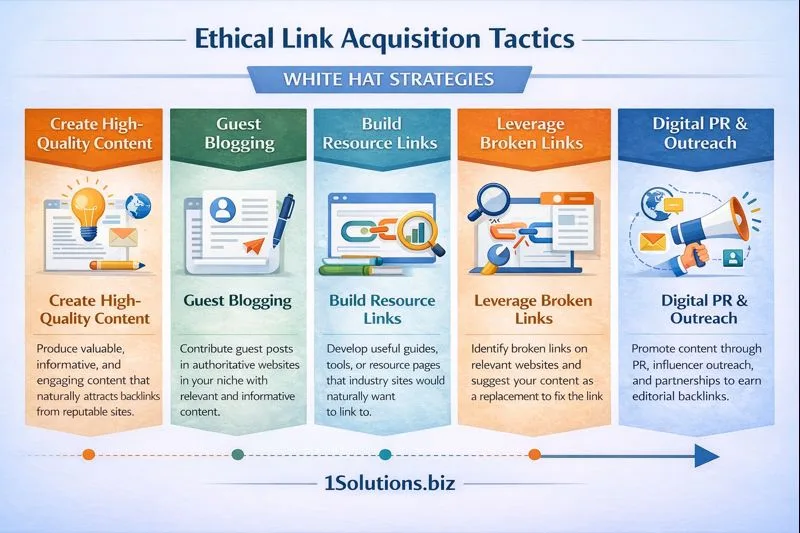
In today’s SEO landscape, ethical link acquisition is critical for building a sustainable and authoritative backlink profile.
Unlike manipulative or short-term tactics, ethical approaches focus on creating genuine value for both users and referring websites.
This ensures that links remain effective over time and continue to support search engine trust-even as algorithms evolve.
Backlinks acquired ethically signal credibility, relevance, and expertise, helping organizations maintain authority without risking penalties.
They also complement other SEO strategies, such as content marketing, local SEO, and technical optimization, to deliver measurable, long-term impact.
Best Practices for Ethical Link Acquisition
1. Create Link-Worthy Content
Produce content that naturally attracts links by offering unique insights, actionable strategies, proprietary research, or high-value resources. The goal is to create material that others want to reference because it provides real value, not because of outreach alone.
2. Conduct Personalised Outreach
Engage directly with relevant publishers, bloggers, and industry influencers. Personalized outreach demonstrates professionalism, builds relationships, and increases the likelihood that your content will be linked in contextually appropriate ways.
3. Leverage Data-Driven Storytelling
Content supported by compelling data, visuals, or case studies is more likely to be shared and cited. Incorporating statistics, trends, and evidence-based insights enhances credibility and makes it easier for other sites to justify linking to your content.
4. Build Strategic Partnerships
Collaborate with complementary brands, associations, or thought leaders on content projects, guides, or campaigns. Strategic partnerships can result in mutually beneficial backlinks while expanding reach and brand authority.
5. Monitor Backlink Quality Regularly
Continuously audit your backlink profile to identify and remove low-quality, spammy, or irrelevant links. Maintaining a clean, authoritative link profile protects your rankings and ensures long-term SEO health.
The Benefits of Ethical Link Acquisition
Adopting an ethical approach to link building:
- Minimizes the risk of penalties or algorithmic devaluation
- Reinforces brand authority and credibility within the industry
- Supports sustainable SEO performance and long-term growth
- Creates opportunities for organic referral traffic and audience engagement
In 2026, ethical link acquisition is not just a best practice-it is an essential component of a resilient SEO strategy. When executed thoughtfully, it aligns with broader digital marketing initiatives, strengthens domain authority, and enhances both visibility and trust across search engines and users alike.
Metrics and KPIs Every SEO Should Track
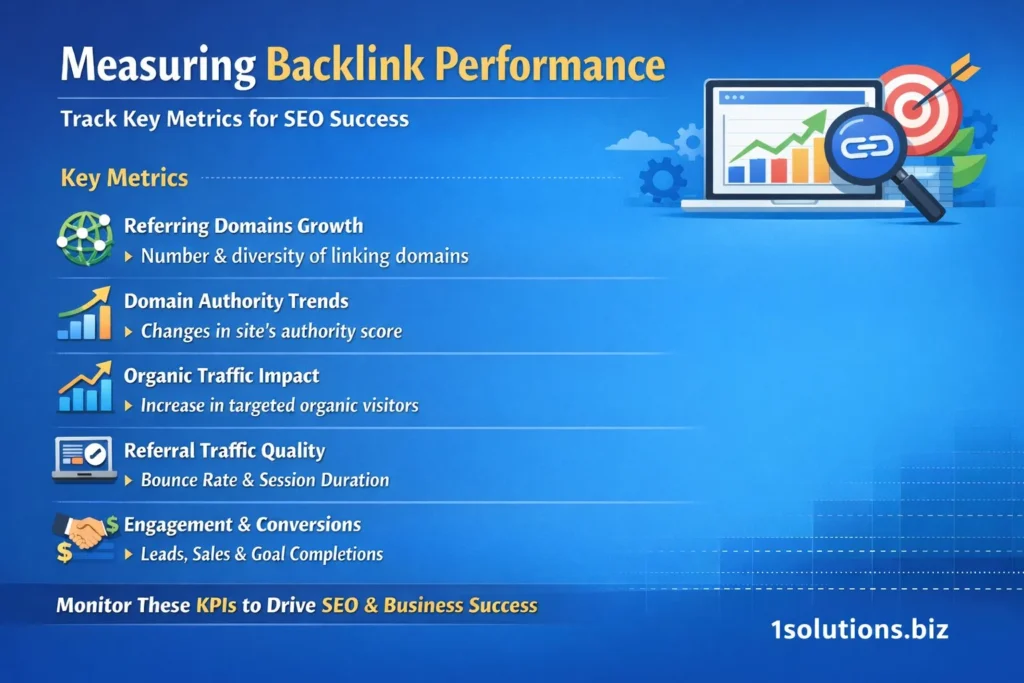
Measuring the performance of backlinks is critical for assessing the effectiveness of SEO strategies and ensuring alignment with broader business goals. Tracking the right metrics allows organizations to optimize efforts, justify investments, and make data-driven decisions.
Key Metrics
Referring domains growth-Monitor the number and diversity of domains linking to your website to assess the breadth and authority of your backlink profile.
- Domain authority trends – Track changes in your site’s overall authority to understand how backlinks are impacting perceived credibility.
- Organic traffic impact-Evaluate the correlation between acquired backlinks and increases in targeted organic traffic.
- Referral traffic quality – Analyse engagement metrics from visitors arriving via backlinks, including session duration, pages per visit, and bounce rates.
- Engagement and conversion metrics – Measure the business impact of backlinks by tracking goal completions, form submissions, leads, and sales generated from referral traffic.
By consistently monitoring these KPIs, SEO leaders can ensure that link-building efforts not only improve search visibility but also contribute meaningfully to overall business performance.
Common Backlink Myths Debunked
Despite their long-standing role in SEO, backlinks are often misunderstood. Here, we clarify five common myths and explain why relying on outdated assumptions can hinder results.
1. More Links Do Not Guarantee Better Rankings
Quantity alone is no longer a reliable metric for success. Search engines prioritise link quality, relevance, and authority over sheer volume. Thousands of low-value links may have minimal impact and can even raise red flags if they appear unnatural.
2. Paid Links Introduce Long-Term Risk
Buying links to manipulate rankings is explicitly against search engine guidelines. Paid links can result in penalties, devaluation, or loss of ranking authority. Sustainable strategies rely on earned, editorially placed links rather than transactional shortcuts.
3. Irrelevant Links Dilute Authority
Links from websites that are unrelated to your industry or content topic provide little SEO value. Search engines assess topical relevance to ensure backlinks contribute to trust and authority. Irrelevant links may dilute your profile and reduce the impact of high-quality backlinks.
4. Anchor Text Manipulation Is Outdated
Over-optimised anchor text was once a popular tactic to rank for specific keywords. Modern algorithms now prioritise natural, contextually relevant anchor text. Excessive optimisation can trigger penalties and diminish the credibility of your backlink profile.
5. Backlinks Alone Do Not Ensure Success
Backlinks are important, but they are only one component of a holistic SEO strategy. Content quality, technical optimisation, user experience, and engagement metrics all work in tandem with backlinks to drive sustainable search visibility.
By understanding these myths, SEO leaders can avoid common pitfalls and focus on strategies that deliver long-term, measurable impact.
Frequently Asked Questions
- Do backlinks still matter in 2026?
Yes. High-quality, relevant backlinks remain a critical authority and trust signal, helping search engines validate credibility, expertise, and content relevance within competitive search environments. - Is link quantity still important for SEO success?
Link quantity alone is no longer a determining factor. Search engines prioritise link quality, topical relevance, and contextual placement over sheer volume. - Can backlinks negatively impact SEO performance?
Yes. Low-quality, spammy, or manipulative backlinks can weaken trust signals, trigger algorithmic suppression, and limit a website’s ability to rank competitively. - Are backlinks important for local SEO strategies?
Absolutely. Local backlinks reinforce geographic relevance and credibility, supporting stronger visibility in map listings and localized organic search results. - How long do backlinks take to influence rankings?
Backlinks typically begin influencing rankings within three to six months, depending on domain authority, competition, and how well they align with broader SEO efforts. - Do no follow links still provide value in 2026?
Yes. While they may not pass direct ranking equity, no follow links contribute to referral traffic, brand visibility, and a natural, diversified backlink profile. - Should businesses outsource link building activities?
Outsourcing can be beneficial when managed strategically, as professional teams help ensure ethical execution, scalability, and alignment with search engine best practices.
Conclusion
Backlinks in 2026 continue to serve as a foundational pillar of SEO, though their function has become more nuanced. Rather than acting as isolated ranking levers, they now operate as trust and credibility signals within a broader search ecosystem that prioritises relevance, user experience, and content quality.
Organisations that adopt a strategic approach to backlinks—integrating them with robust technical optimisation, localized search initiatives, and consistently high-value content—are better positioned to achieve sustainable search visibility. Implementing a data-driven content and outreach strategy, such as the approach offered by 1Solutions, ensures that backlinks are earned ethically, from authoritative and topically relevant sources.
1Solutions helps businesses create authoritative content, engage in personalised outreach, and build meaningful relationships that naturally generate high-quality backlinks. This approach not only improves search rankings but also drives qualified traffic, strengthens brand credibility, and supports long-term digital growth.
With a cohesive strategy that blends content excellence, backlink acquisition, and technical SEO, organisations can fully leverage modern search engine behaviour, ensuring that every backlink contributes to lasting authority and measurable business results.









 in India