













































































Competitive keywords are search queries that attract a high volume of searches and are targeted by many websites. These keywords often represent significant business value, such as “best CRM software,” “personal loan interest rates,” or “SEO agency for startups.” Because of their potential to drive large amounts of qualified traffic, they are pursued aggressively by established brands, publishers, and industry leaders.
Ranking for these keywords is challenging because the top search results are usually dominated by websites with strong domain authority, deep content libraries, robust backlink profiles, and well-optimized user experiences. In Google’s modern search ecosystem, success is not determined by a single factor. Instead, it is the combined effect of content relevance, technical performance, authority signals, and user satisfaction.
This article explains how to improve Google rankings for competitive keywords using ethical, sustainable, and data-driven SEO practices. It is designed for readers who already understand the fundamentals of SEO and want to compete in high-difficulty search environments.
How Google Evaluates Competition
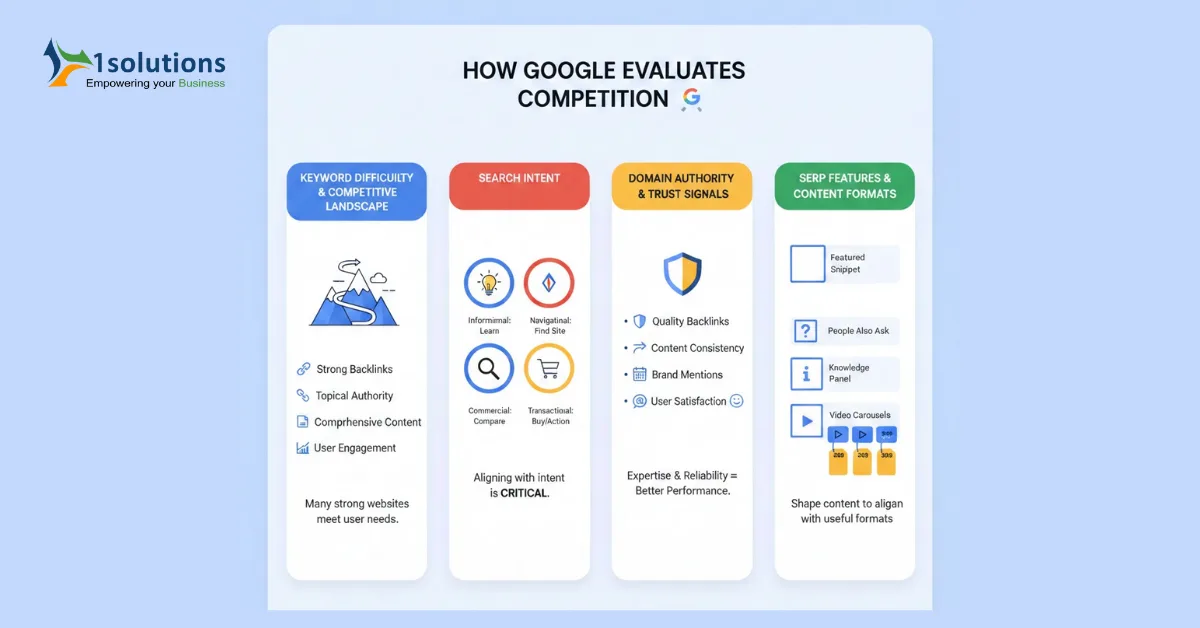
To rank for competitive keywords, it is important to understand how Google evaluates and compares pages. Google’s ranking systems analyze hundreds of signals to determine which pages best satisfy a user’s query.
Keyword Difficulty and Competitive Landscape
Keyword difficulty is not a metric used directly by Google, but it is a useful concept for SEOs. It reflects how hard it is to rank based on the strength of the current top-ranking pages. Difficulty increases when competitors have:
- Strong backlink profiles from authoritative domains
- Long-standing topical authority
- Comprehensive, well-maintained content
- Strong user engagement signals
When a keyword is highly competitive, it means that many strong websites are already meeting user needs effectively.
Search Intent
Search intent refers to the reason behind a user’s query. It generally falls into four categories:
- Informational: The user wants to learn something
- Navigational: The user wants to reach a specific site or brand
- Commercial investigation: The user is comparing options
- Transactional: The user wants to buy or take an action
For competitive keywords, aligning with intent is critical. A page that perfectly matches user intent can outrank a stronger domain that misses the mark.
Domain Authority and Trust Signals
Google does not publish a domain authority score, but it does evaluate trust and credibility through signals such as:
- Quality and relevance of inbound links
- Historical consistency in publishing useful content
- Brand mentions and recognition
- User behavior and satisfaction
Domains that consistently demonstrate expertise and reliability tend to perform better for difficult keywords.
SERP Features and Content Formats
Modern search results include many features beyond traditional blue links. These may include:
- Featured snippets
- People Also Ask boxes
- Knowledge panels
- Video carousels
- Product listings
Understanding which formats dominate the SERP helps you shape your content in ways that align with what Google already considers useful for that query.
Must Read: How to Improve Local Rankings for Service Businesses in Los Angeles
Advanced Keyword Research for Competitive Niches
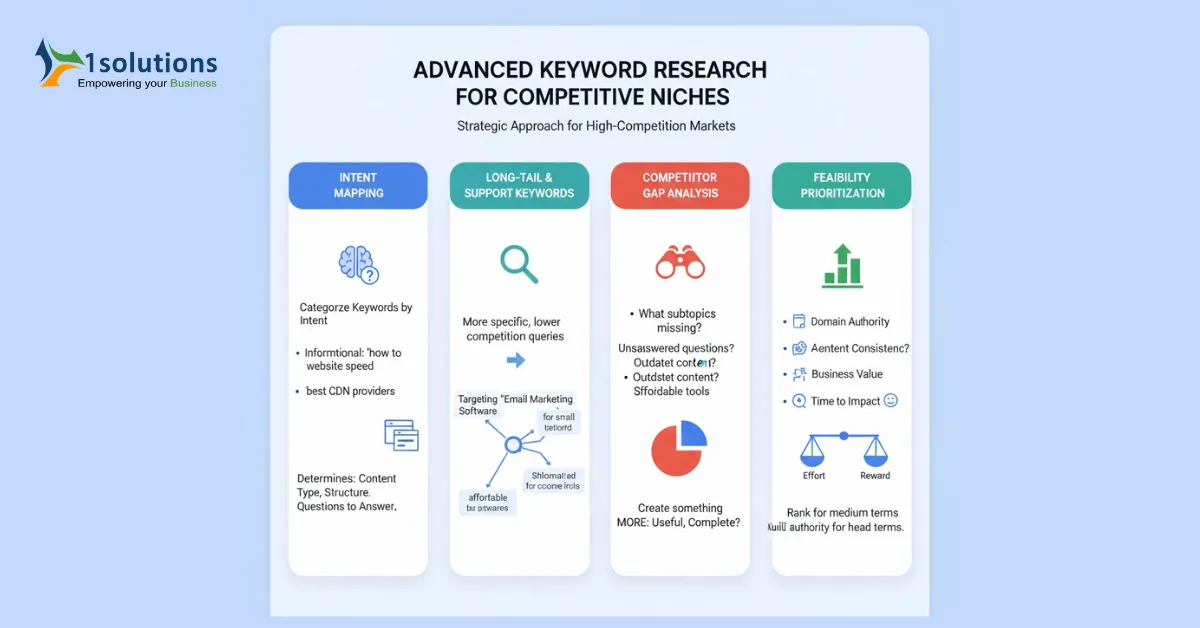
Basic keyword research is not enough when competition is high. You need a strategic approach that focuses on intent, topical coverage, and feasibility.
Intent Mapping
Start by categorizing keywords based on their underlying intent. For example, a keyword like “how to improve website speed” is informational, while “best CDN providers” suggests commercial investigation.
Mapping intent helps you determine:
- What type of content to create
- How to structure the page
- What questions must be answered
Failing to match intent is one of the most common reasons pages fail to rank.
Long-Tail and Support Keywords
Long-tail keywords are more specific queries with lower competition. They often reflect clearer intent and can be used to build topical relevance.
For example, instead of targeting only “email marketing software,” you can support it with pages like:
- Email marketing software for small businesses
- Email marketing automation for ecommerce
- Affordable email marketing tools
These pages help establish your authority in the topic and strengthen your ability to rank for broader terms.
Competitor Gap Analysis
Analyze the top-ranking pages and look for gaps in their coverage. Ask questions such as:
- What subtopics are missing?
- Are there unanswered questions in the comments or forums?
- Is the content outdated?
- Is the information shallow or vague?
Your goal is not to copy competitors but to create something more useful, more complete, and more current.
Feasibility Prioritization
Not all competitive keywords are worth pursuing immediately. Consider:
- Your domain’s existing authority
- Available resources
- Expected business value
- Time to impact
Sometimes, ranking for several medium-difficulty keywords can create the authority needed to later compete for high-difficulty head terms.
Creating Content That Outperforms the Competition
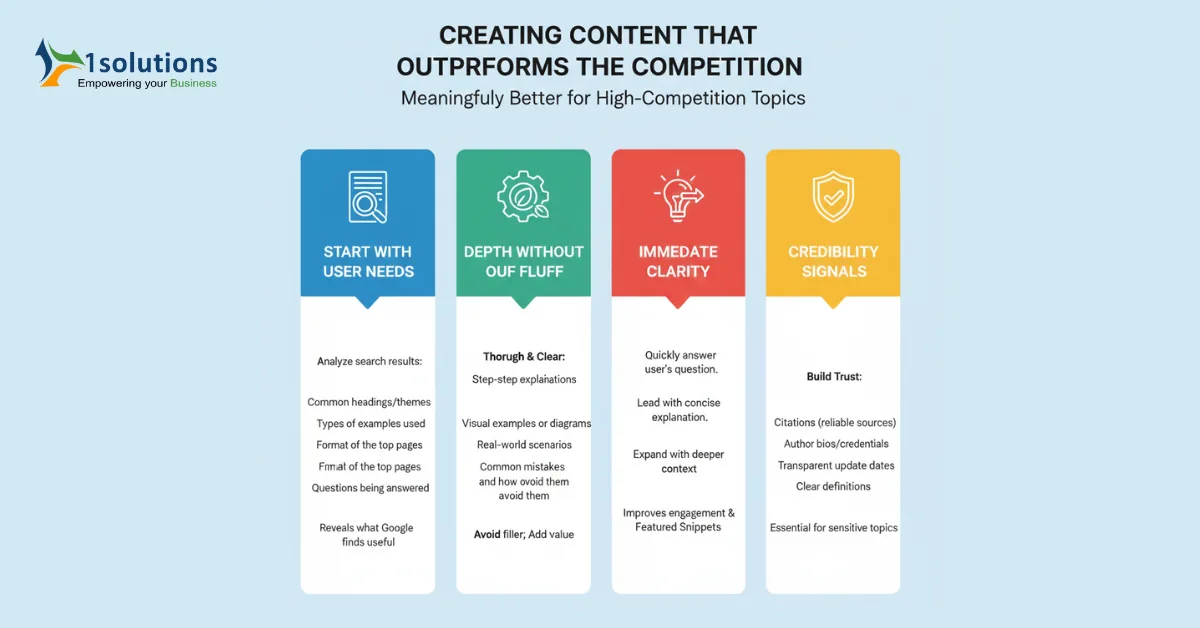
When competition is intense, average content does not succeed. Your content must be meaningfully better.
Start With User Needs
The foundation of strong content is clarity about what users want. Analyze search results to understand:
- Common headings and themes
- Types of examples used
- Format of the top pages
- Questions being answered
This reveals what Google already believes is useful.
Depth Without Fluff
Depth does not mean length for its own sake. It means addressing a topic thoroughly, clearly, and practically.
High-quality content often includes:
- Step-by-step explanations
- Visual examples or diagrams
- Real-world scenarios
- Common mistakes and how to avoid them
- Clear summaries
Avoid filler content that adds word count without adding value.
Immediate Clarity
Users should quickly understand whether your page answers their question. Lead with concise explanations, then expand with deeper context.
This approach improves engagement and increases the chance of earning featured snippets.
Credibility Signals
Where applicable, include:
- Citations to reliable sources
- Author bios or credentials
- Transparent update dates
- Clear definitions
These elements help establish trust, especially in sensitive or high-stakes topics.
On-Page SEO for Competitive Keywords
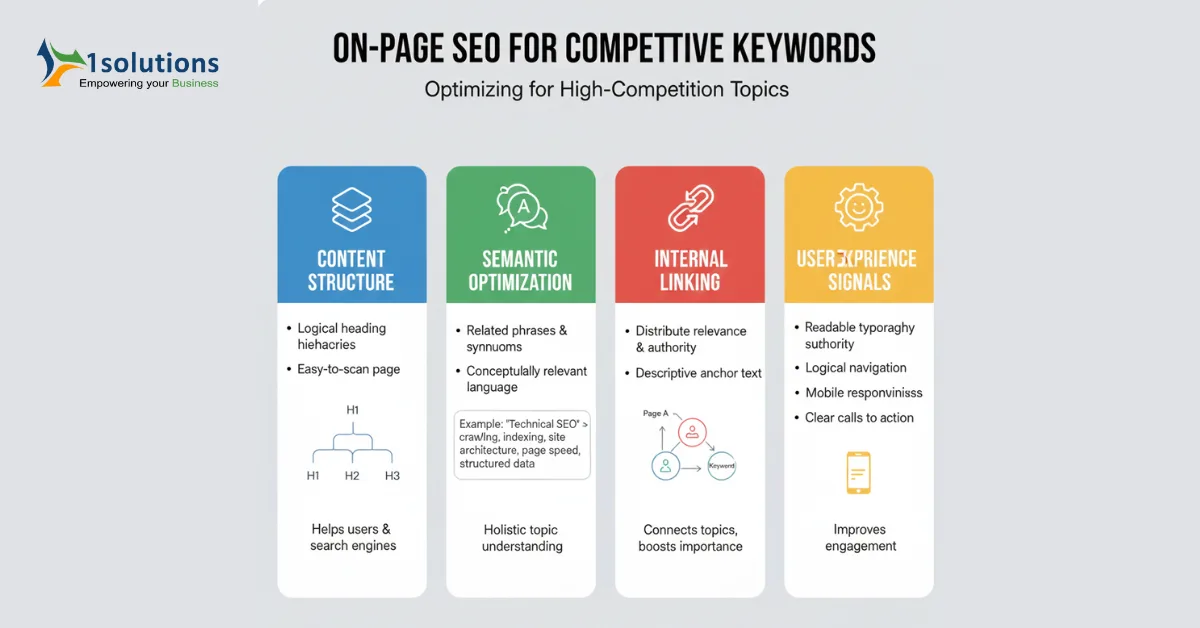
On-page optimization becomes more important as competition increases.
Content Structure
Use logical heading hierarchies that make the page easy to scan. A well-structured page helps both users and search engines understand what each section covers.
Semantic Optimization
Instead of repeating the same keyword, use related phrases, synonyms, and conceptually relevant language. This helps Google understand the topic holistically.
For example, a page about “technical SEO” might naturally reference crawling, indexing, site architecture, page speed, and structured data.
Internal Linking
Internal links distribute relevance and authority across your site. Link from related pages using descriptive anchor text.
This helps search engines understand which pages are most important and how topics relate.
User Experience Signals
Good UX supports SEO by reducing friction. Focus on:
- Readable typography
- Logical navigation
- Mobile responsiveness
- Clear calls to action
Pages that are easier to use tend to perform better in engagement metrics.
The Role of Technical SEO
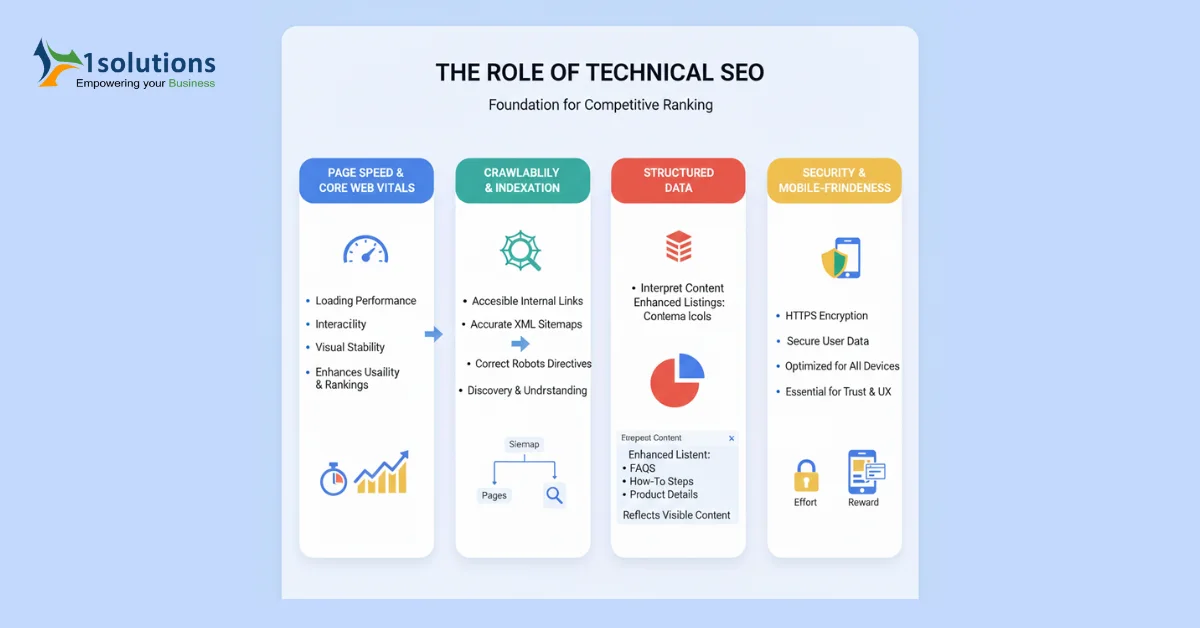
Technical SEO provides the foundation that allows your content to compete.
Page Speed and Core Web Vitals
Google measures real-world performance using Core Web Vitals, which focus on:
- Loading performance
- Interactivity
- Visual stability
Improving these metrics enhances usability and can indirectly influence rankings.
Crawlability and Indexation
Ensure that:
- Important pages are accessible via internal links
- XML sitemaps are accurate
- Robots directives are correct
- Canonical tags are properly set
Search engines must be able to discover and understand your pages efficiently.
Structured Data
Structured data helps search engines interpret your content. It can enable enhanced listings like FAQs, how-to steps, and product details.
Only use schema that accurately reflects the visible content.
Off-Page SEO and Authority Building
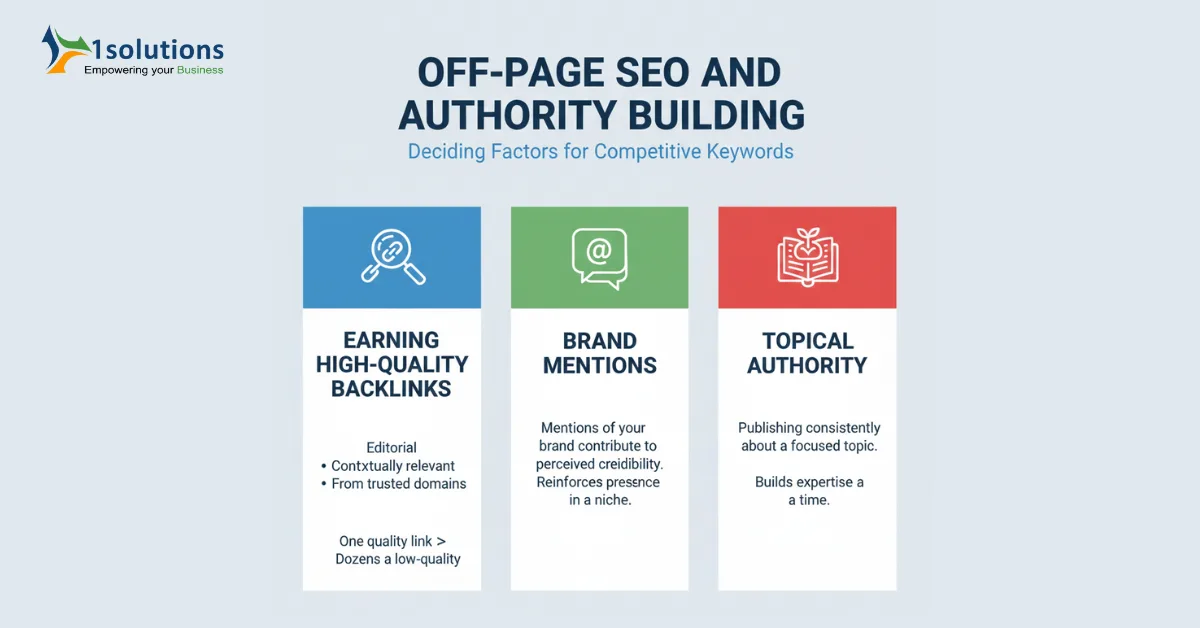
For competitive keywords, authority often becomes the deciding factor.
Earning High-Quality Backlinks
Focus on links that are:
- Editorial
- Contextually relevant
- From trusted domains
One high-quality link can outweigh dozens of low-quality ones.
Brand Mentions
Mentions of your brand, even without links, contribute to perceived credibility. These signals help reinforce your presence in a niche.
Topical Authority
Publishing consistently about a focused topic helps build topical authority. Over time, search engines associate your site with expertise in that area.
Must Read: Link Building Techniques to Avoid in 2026
Long-Term Strategies: Freshness and Optimization
Competitive rankings require ongoing effort.
Content Updates
Refresh content with new examples, updated data, and refined explanations. This keeps your page relevant.
Topical Clustering
Organize content into clusters around pillar pages. This structure helps distribute relevance and improves crawl efficiency.
Snippet Optimization
Test titles and meta descriptions to improve click-through rates. Higher engagement often correlates with better performance.
Tracking and Iterating
SEO for competitive keywords is a long-term process.
Key Metrics to Monitor
Track:
- Impressions and clicks
- Average position
- Engagement metrics
- Backlink growth
- Technical health
Review Cadence
Adopt a consistent review schedule:
- Weekly: errors and anomalies
- Monthly: content and link growth
- Quarterly: strategy reassessment
Decision Framework
If a page gets impressions but few clicks, refine your snippets. Or if it gets clicks but low engagement, improve content quality. If it stagnates, strengthen internal links and authority signals.
Frequently Asked Questions
1. What makes a keyword competitive in Google search?
A keyword becomes competitive when many high-authority websites are actively targeting it and ranking with strong content, backlinks, and engagement signals. These keywords usually have high search volume, strong commercial or informational value, and established brands dominating the top results.
2. Can new websites rank for competitive keywords?
Yes, but it usually takes longer. New websites need to build topical authority, publish high-quality content, earn trustworthy backlinks, and demonstrate consistent user value. Targeting long-tail variations first often helps build the foundation needed to compete for broader terms.
3. How long does it take to rank for competitive keywords?
There is no fixed timeline. Depending on your domain strength, content quality, competition, and link profile, it can take several months to over a year. SEO for competitive keywords is a long-term strategy rather than a quick win.
4. Is backlink building still important for competitive SEO?
Yes. While content quality and user experience are critical, backlinks remain a major ranking factor. For competitive keywords, authoritative and relevant backlinks often make the difference between page one and page two.
5. Does content length matter for competitive keywords?
Length alone does not matter, but depth and completeness do. Pages that thoroughly cover a topic, answer related questions, and provide practical value usually perform better than short or surface-level content.
6. How do Core Web Vitals affect rankings for competitive keywords?
Core Web Vitals influence page experience, which can affect rankings, especially when content relevance is similar across competing pages. Faster load times, better interactivity, and visual stability improve user satisfaction and engagement.
7. Should I update my content regularly for competitive keywords?
Yes. Regular updates help maintain relevance, improve accuracy, and reflect new information or trends. Freshness can be an advantage, especially in industries where information changes frequently.
Conclusion
Ranking for competitive keywords requires more than basic optimization. It demands a structured, user-first strategy built on data, quality, and consistency. Success comes from deeply understanding and matching user intent, creating content that is demonstrably more helpful than what already exists, and building topical authority steadily over time.
Equally important is maintaining strong technical foundations so that search engines can crawl, index, and evaluate your pages without friction. Finally, long-term visibility depends on continuously measuring performance, analyzing user behavior, and refining your strategy based on real-world data rather than assumptions.
By following these principles, you can build sustainable visibility in competitive search landscapes without relying on shortcuts or risky tactics.











 in India