














































































Search is changing fast. Large Language Models (LLMs) now power search engines and answer user questions directly. This shift creates new opportunities and challenges for businesses wanting to rank high in search results.
LLM Optimization (LLMO) represents the next evolution of search engine optimization. While traditional SEO focuses on ranking web pages, LLMO centers on getting your content featured in AI-generated responses and conversational search results.
Understanding LLMO helps your business stay competitive as search behavior evolves. This guide covers everything you need to know about optimizing for AI-driven search engines and LLM-powered tools.
Understanding LLM Optimization and Its Importance
LLM Optimization involves creating and structuring content that AI language models can easily understand, process, and reference. Unlike traditional search engines that return lists of links, LLMs provide direct answers by synthesizing information from multiple sources.
When users ask questions through ChatGPT, Google’s AI Overviews, or Bing Chat, these systems scan vast amounts of content to generate responses. Your goal is to make your content so valuable and well-structured that LLMs choose it as a primary source.
Why LLMO Matters for Your Business
AI-powered search tools are becoming mainstream. Google processes billions of queries daily, and many now trigger AI-enhanced results. Microsoft’s integration of AI into Bing and the rise of ChatGPT as a search alternative show this trend accelerating.
Businesses that optimize for LLMs gain several advantages:
- Higher visibility in AI-generated responses
- Increased brand authority and trust
- Better user engagement through relevant content
- Future-proofing against search algorithm changes
- Improved organic traffic from various AI platforms
The AI SEO strategies that work today will only become more important as search continues evolving toward conversational and contextual results.
How LLMs Process and Understand Content
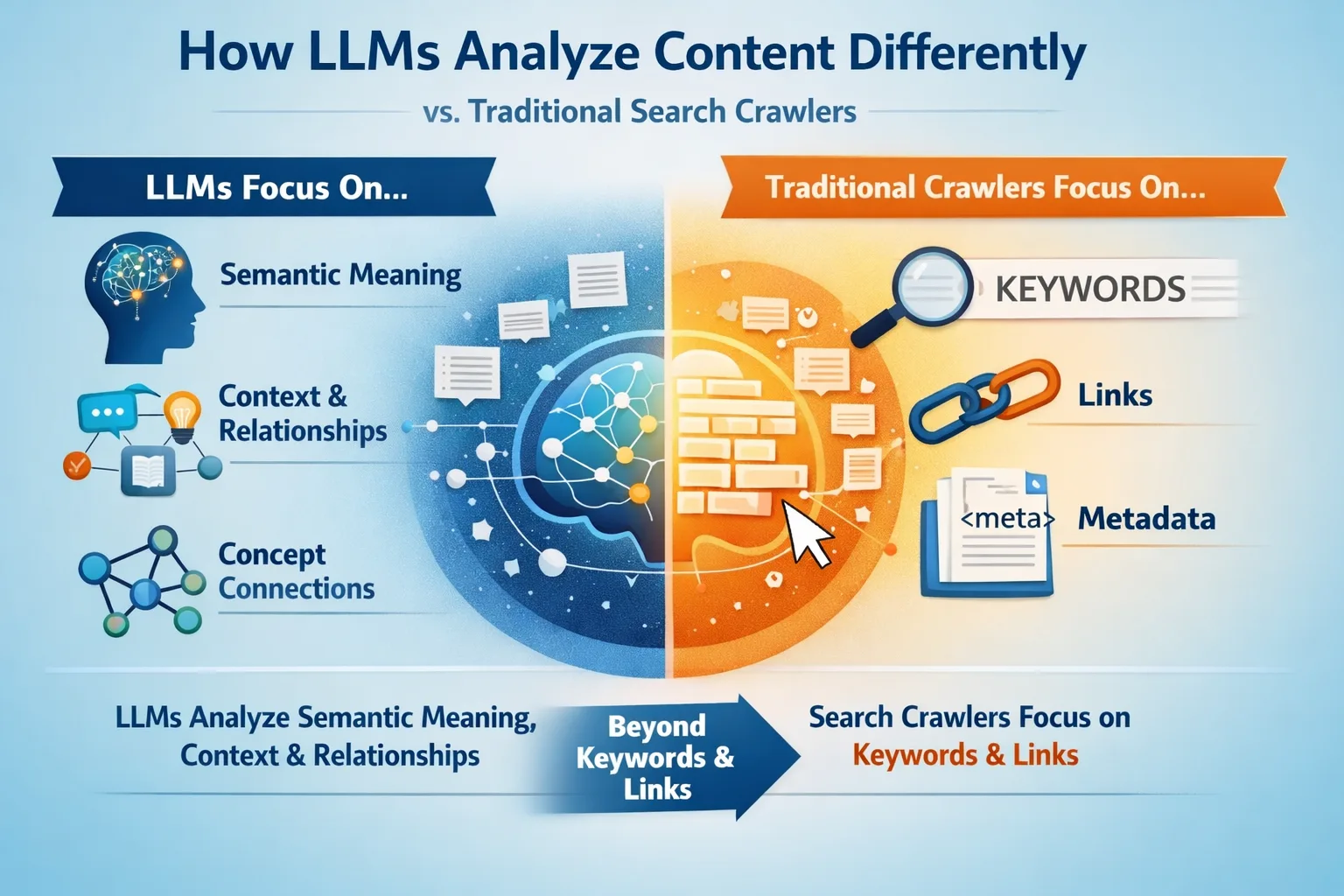
LLMs analyze content differently than traditional search crawlers. They focus on semantic meaning, context, and the relationships between concepts rather than just keywords and links.
Content Processing Methods
LLMs break down content into tokens (words or word parts) and analyze patterns across massive datasets. They identify concepts, relationships, and factual information that helps answer user queries.
When processing your content, LLMs evaluate:
- Factual accuracy and consistency
- Clarity and logical structure
- Depth of information provided
- Authority signals and source credibility
- Relevance to common questions
This processing differs from traditional SEO metrics like keyword density or backlink counts. LLMs prioritize content quality and usefulness over technical optimization tricks.
Context and Semantic Understanding
Modern LLMs excel at understanding context and nuance. They can distinguish between different meanings of the same word and understand implied relationships between concepts.
For example, if someone asks about “apple stock performance,” an LLM knows they mean Apple Inc. shares, not fruit inventory. This contextual awareness means your content must be clear and specific about the topics it covers.
Creating content that addresses user intent directly improves your chances of being referenced by LLMs. Focus on answering questions completely rather than optimizing for specific keyword phrases.
Key Differences Between Traditional SEO and LLMO
Traditional SEO and LLMO share some principles but differ in crucial ways. Understanding these differences helps you adapt your content strategy for AI-driven search.
Content Focus and Structure
Traditional SEO often emphasized keyword placement, meta tags, and link building. LLMO prioritizes content quality, factual accuracy, and comprehensive coverage of topics.
While traditional SEO might target specific keyword phrases, LLMO focuses on semantic topics and natural language patterns. Your content should sound conversational and address real user questions.
The shift toward voice search optimization already demonstrated this trend toward natural language queries. LLMO extends this concept further by optimizing for conversational AI interactions.
Ranking Factors and Signals
Traditional ranking factors like page speed and backlinks remain important, but LLMs add new considerations:
- Content Authority: LLMs favor authoritative sources with proven expertise
- Information Completeness: Comprehensive coverage of topics performs better
- Factual Accuracy: Incorrect information reduces content credibility
- Source Attribution: Clear citations and references boost trustworthiness
- Update Frequency: Current information receives priority over outdated content
These factors align with Google’s E-E-A-T guidelines (Experience, Expertise, Authoritativeness, Trustworthiness) but with greater emphasis on content quality over technical factors.
User Experience Considerations
Traditional SEO focused on getting users to click through to your website. LLMO often involves providing information that AI systems can reference without requiring a click.
This shift means your content might be cited in AI responses without driving direct traffic. However, this exposure builds brand authority and can lead to increased searches for your business name and services.
Essential LLMO Strategies for Better Rankings
Successful LLMO requires specific strategies that align with how LLMs process and prioritize content. These approaches help your content get recognized and referenced by AI systems.
Create Comprehensive, Authoritative Content
LLMs favor content that thoroughly covers topics with expertise and authority. Instead of writing multiple short articles, create comprehensive guides that address all aspects of a subject.
Your content should:
- Answer questions completely with supporting details
- Include relevant examples and case studies
- Provide actionable insights and recommendations
- Cover related subtopics within the main subject
- Reference credible sources and data
This approach aligns with creating technical SEO content that serves both users and search algorithms effectively.
Optimize for Question-Based Queries
LLMs excel at answering direct questions. Structure your content to address common questions in your industry using natural language patterns.
Research the questions your target audience asks using:
- Google’s “People Also Ask” sections
- Industry forums and discussion boards
- Customer service inquiries
- Social media conversations
- Keyword research tools
Create sections that directly answer these questions with clear, concise responses followed by detailed explanations.
Use Structured Data and Clear Formatting
LLMs process structured information more effectively than dense paragraphs. Use formatting that makes your content easy to parse:
- Headers and Subheaders: Create clear information hierarchy
- Bullet Points and Lists: Organize information logically
- Tables and Charts: Present data in digestible formats
- Schema Markup: Help AI understand content context
- Short Paragraphs: Improve readability and processing
Well-structured content helps both users and AI systems quickly find relevant information.
Content Creation Best Practices for LLM Visibility
Creating content that performs well in LLMO requires specific approaches that differ from traditional content marketing. These practices help your content get noticed and referenced by AI systems.
Focus on Topic Clusters and Semantic Relevance
Instead of targeting individual keywords, create content clusters around broad topics. This approach helps establish topical authority and provides comprehensive coverage that LLMs value.
Develop pillar content that covers main topics extensively, then create supporting content that explores specific aspects in detail. Link these pieces together to show relationships and provide complete topic coverage.
This strategy works particularly well for businesses offering specialized services. For example, local SEO services can be covered through multiple related articles that address different aspects of local optimization.
Write in Natural, Conversational Language
LLMs are trained on human language patterns and respond well to natural, conversational content. Avoid overly technical jargon unless necessary, and explain complex concepts in simple terms.
Use the same language your customers use when discussing your industry. This approach helps your content align with how people actually search and ask questions.
Consider how people might ask questions verbally and structure your content to address these natural language queries. This alignment with voice search optimization principles benefits both traditional search and LLM visibility.
Include Specific Examples and Case Studies
LLMs value concrete examples that illustrate abstract concepts. Include specific case studies, examples, and real-world applications in your content.
These examples serve multiple purposes:
- Make complex information more understandable
- Provide proof for claims and assertions
- Help LLMs understand practical applications
- Increase content engagement and shareability
- Build credibility through demonstrated results
When discussing strategies or concepts, always include practical examples that show how these ideas work in practice.
Maintain Factual Accuracy and Citations
LLMs are increasingly sophisticated at identifying and flagging inaccurate information. Ensure all factual claims in your content are accurate and properly supported.
Best practices for accuracy include:
- Citing reputable sources for statistics and claims
- Linking to original research and studies
- Updating content regularly to reflect current information
- Fact-checking all numerical data and dates
- Clearly distinguishing between opinions and facts
Accurate, well-sourced content builds trust with both users and AI systems, improving your chances of being referenced in AI-generated responses.
Technical Implementation of LLMO
Technical optimization for LLMO builds on traditional SEO foundations while adding new considerations for AI processing. These technical elements help LLMs better understand and index your content.
Schema Markup and Structured Data
Schema markup helps AI systems understand the context and meaning of your content. Implement structured data that clearly identifies:
- Article types and categories
- Author information and credentials
- Publication and update dates
- Business information and services
- FAQ sections and Q&A content
Rich snippets created through schema markup also improve traditional search visibility, making this optimization valuable for both traditional SEO and LLMO.
The importance of proper technical implementation extends to issues like ensuring your pages are properly indexed. Understanding why Google might not be indexing your page helps ensure AI systems can access your content.
Site Performance and Accessibility
Fast-loading, accessible websites provide better experiences for both users and AI crawlers. Focus on:
- Page Speed: Optimize loading times for better user experience
- Mobile Responsiveness: Ensure content works across all devices
- Clean Code: Use valid HTML and CSS that AI systems can parse easily
- Navigation Structure: Create logical site architecture
- Internal Linking: Connect related content effectively
These technical factors support both traditional search rankings and AI content discovery. Poor technical implementation can prevent AI systems from properly accessing and understanding your content.
Content Organization and URL Structure
Organize your content in ways that help both users and AI systems understand your site structure. Use descriptive URLs, logical navigation, and clear content hierarchies.
Create topic-based content organization that groups related articles together. This approach helps establish topical authority and makes it easier for AI systems to understand your expertise areas.
Proper internal linking helps AI systems understand relationships between your content pieces and can improve the authority of individual pages.
Measuring LLMO Success and Performance
Measuring LLMO success requires different metrics than traditional SEO. While traffic and rankings remain important, new metrics help track AI visibility and engagement.
Key Performance Indicators for LLMO
Track these metrics to measure your LLMO performance:
- AI Citation Frequency: How often AI systems reference your content
- Brand Mention Volume: Increases in brand name searches
- Direct Traffic Growth: Users finding you through AI recommendations
- Content Engagement Metrics: Time on page and interaction rates
- Authority Signals: Backlinks from AI-cited content
These metrics help you understand how well your content performs in AI-driven search environments.
Tools and Methods for Tracking
Several tools can help monitor your LLMO performance:
- Google Analytics: Track traffic sources and user behavior
- Search Console: Monitor search performance and indexing
- Brand Monitoring Tools: Track mentions across AI platforms
- Content Analytics: Measure engagement and sharing metrics
- AI Platform Monitoring: Check citations in ChatGPT and similar tools
Regular monitoring helps you understand which content performs best with AI systems and adjust your strategy accordingly.
The integration of AI SEO tools in your measurement process can provide additional insights into how well your content aligns with AI preferences and behaviors.
Continuous Improvement Strategies
LLMO requires ongoing optimization based on performance data and changing AI capabilities. Regularly update your content to maintain relevance and accuracy.
Monitor which topics and content formats perform best with AI systems, then create more content following those successful patterns. This iterative approach helps you refine your LLMO strategy over time.
Industry-Specific LLMO Applications
Different industries can benefit from specialized LLMO approaches that address their unique challenges and opportunities. Understanding industry-specific applications helps create more effective strategies.
Local Business Optimization
Local businesses can leverage LLMO to improve visibility in location-based AI queries. When users ask AI systems about local services, well-optimized local businesses have better chances of being recommended.
Focus on creating content that addresses local questions and concerns. Include location-specific information, local examples, and community-relevant details in your content.
The principles of Google My Business optimization extend to LLMO by ensuring your business information is accurate and comprehensive across all platforms.
Local businesses should also avoid common Google My Business mistakes that can hurt their visibility in both traditional search and AI-powered local recommendations.
E-commerce and Product-Focused Content
E-commerce businesses can optimize product information and buying guides for AI recommendations. Create comprehensive product comparisons, buying guides, and educational content that helps users make informed decisions.
AI systems often reference detailed product information when answering shopping-related queries. Ensure your product descriptions, specifications, and comparison content are thorough and accurate.
Understanding eCommerce website building platforms helps create technical foundations that support both user experience and AI content discovery.
Service-Based Business Applications
Service-based businesses should create content that educates potential customers about their services and industry. Answer common questions about processes, pricing, and benefits.
For example, businesses offering plumbing SEO services can create content that explains SEO concepts, processes, and benefits specifically for plumbing companies.
This educational approach builds trust and authority while providing valuable information that AI systems can reference when users ask related questions.
Future Trends and Developments in LLMO
LLMO continues evolving as AI technology advances and search behavior changes. Understanding future trends helps prepare your content strategy for upcoming developments.
Emerging AI Technologies
New AI technologies will create additional optimization opportunities. Multimodal AI systems that process text, images, and video together will require content strategies that address multiple formats.
Visual search capabilities are expanding, making image optimization and visual content creation increasingly important for LLMO success.
The integration of AI into various platforms means LLMO principles will apply beyond traditional search engines to social media, e-commerce platforms, and specialized industry tools.
Search Behavior Evolution
User behavior continues shifting toward conversational and contextual queries. People increasingly use AI assistants for complex research tasks that require synthesizing information from multiple sources.
This trend emphasizes the importance of comprehensive, authoritative content that can serve as reliable reference material for AI systems.
Understanding developments like Google AI Mode helps businesses prepare for changes in how search results are presented and how users interact with search engines.
Integration with Traditional SEO
LLMO will not replace traditional SEO but will integrate with existing optimization practices. The most successful strategies will combine traditional SEO foundations with LLMO-specific optimizations.
Businesses that start implementing LLMO practices now will have competitive advantages as AI-driven search becomes more prevalent.
The future likely involves hybrid approaches that optimize for both traditional search engines and AI systems simultaneously, requiring comprehensive strategies that address multiple ranking factors and user behaviors.
Common LLMO Mistakes to Avoid
Avoiding common mistakes helps your LLMO efforts succeed more effectively. Understanding these pitfalls prevents wasted effort and improves your optimization results.
Over-Optimization and Keyword Stuffing
Traditional SEO mistakes like keyword stuffing become even more problematic with LLMO. AI systems are sophisticated at detecting unnatural language patterns and low-quality content.
Focus on creating valuable, natural content rather than trying to manipulate AI algorithms. LLMs prioritize content quality and user value over keyword density and technical tricks.
Neglecting Content Quality for Quantity
Creating large volumes of low-quality content does not improve LLMO performance. AI systems favor authoritative, comprehensive content over numerous shallow articles.
Invest time in creating fewer, higher-quality pieces that thoroughly address topics rather than producing many brief articles with limited value.
Ignoring User Intent and Context
Content that does not address actual user needs and questions will not perform well with AI systems. Research what your audience actually wants to know and create content that provides complete, helpful answers.
Understanding user intent helps create content that aligns with how people interact with AI assistants and search engines.
Building Your LLMO Strategy
Creating an effective LLMO strategy requires careful planning and systematic implementation. Start with a solid foundation and build gradually as you learn what works best for your industry and audience.
Assessment and Planning
Begin by assessing your current content and identifying opportunities for LLMO optimization. Analyze which content already performs well and understand why it succeeds.
Develop a content plan that addresses your audience’s most important questions and concerns. Prioritize topics where you have genuine expertise and can provide unique insights.
Consider working with professionals who understand both traditional SEO and emerging LLMO practices. Expertise in both areas helps create comprehensive strategies that perform well across all search environments.
Implementation and Testing
Implement LLMO optimizations gradually, testing different approaches to see what works best for your specific situation. Monitor performance metrics and adjust your strategy based on results.
Start with your most important content pieces and optimize them thoroughly before expanding to additional content. This focused approach helps you understand what works without spreading efforts too thin.
Many businesses benefit from professional guidance when implementing comprehensive LLMO strategies. Understanding complex optimization requirements helps ensure your efforts produce meaningful results.
Frequently Asked Questions
What is the main difference between SEO and LLMO?
SEO focuses on ranking web pages in search engine results, while LLMO optimizes content to be referenced and cited by AI language models in their responses. LLMO emphasizes content quality, accuracy, and comprehensive coverage over traditional ranking factors like backlinks and keyword density.
How do I know if my content is being used by AI systems?
Monitor brand mentions and direct traffic increases that cannot be attributed to traditional search or marketing channels. Use brand monitoring tools to track citations across AI platforms. Look for increases in branded searches and direct website visits that might result from AI recommendations.
Does LLMO replace traditional SEO completely?
No, LLMO complements rather than replaces traditional SEO. Many ranking factors like site speed, mobile responsiveness, and technical optimization remain important for both traditional search and AI visibility. The most effective strategies combine both approaches.
What types of content perform best for LLMO?
Comprehensive, authoritative content that thoroughly answers specific questions performs best. Educational content, detailed guides, case studies with specific examples, and content that addresses common user questions tend to be referenced more frequently by AI systems.
How often should I update my content for LLMO?
Update content regularly to maintain accuracy and relevance. Review and refresh content at least quarterly, or more frequently for rapidly changing topics. AI systems favor current, accurate information over outdated content, even if the older content was previously well-optimized.
Can small businesses compete with larger companies in LLMO?
Yes, small businesses can compete effectively in LLMO by creating highly specialized, authoritative content in their niche areas. Focus on local expertise, specific industry knowledge, and detailed customer service information that larger competitors might overlook.
How long does it take to see results from LLMO optimization?
LLMO results typically take 3-6 months to become apparent, similar to traditional SEO. However, since AI systems update more frequently than traditional search indexes, some improvements might be visible sooner. Consistent, high-quality content creation accelerates results over time.
Conclusion
LLM Optimization represents the next evolution in search engine optimization. As AI-powered search becomes more prevalent, businesses that understand and implement LLMO strategies will have significant competitive advantages.
Success in LLMO requires focusing on content quality, user value, and comprehensive topic coverage. While technical optimization remains important, the emphasis shifts toward creating genuinely helpful, authoritative content that serves both users and AI systems effectively.
The businesses that start implementing LLMO practices now will be best positioned for future search evolution. By building content strategies that address both current search needs and emerging AI capabilities, you create sustainable competitive advantages that grow stronger over time.
Ready to optimize your content for AI-driven search? At 1Solutions, we specialize in comprehensive digital marketing strategies that include both traditional SEO and cutting-edge LLMO optimization. Our team understands how to create content that performs well across all search environments, from traditional Google results to AI-powered assistants. Get a free proposal today to learn how we can help your business succeed in the age of AI-driven search.







 in India