














































































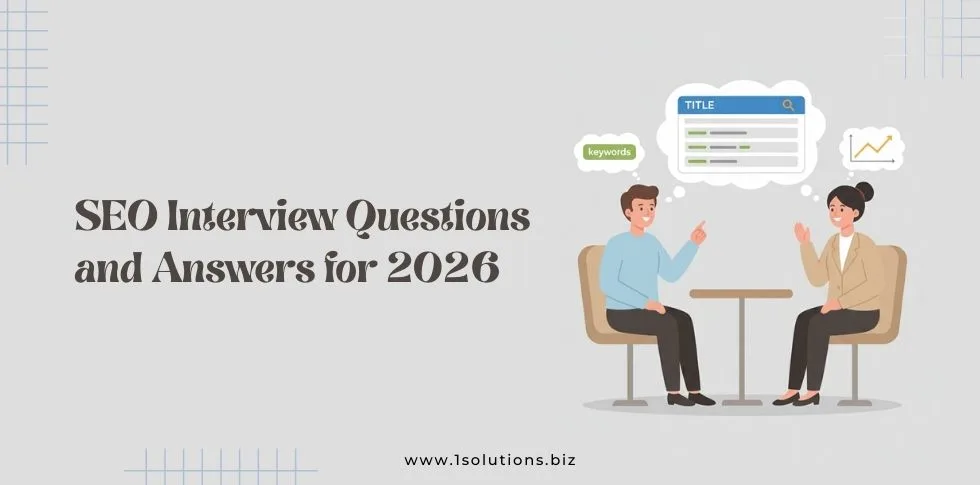
Preparing for an SEO interview can feel overwhelming, especially with how rapidly the field evolves. Search engines constantly update their algorithms, new technologies emerge, and best practices shift. Whether you’re a seasoned professional or just starting your SEO career, having the right preparation makes all the difference.
This comprehensive guide covers the most important SEO interview questions you’ll encounter in 2026. We’ve organized everything by topic to help you study effectively and demonstrate your expertise during interviews.
Basic SEO Concepts and Fundamentals
Every SEO interview starts with fundamental concepts. Interviewers want to ensure you understand the core principles before diving into advanced topics.
What is SEO and why is it important for businesses?
Answer: SEO (Search Engine Optimization) is the practice of optimizing websites to improve their visibility in search engine results pages. It’s crucial for businesses because organic search drives over 50% of website traffic. SEO helps companies attract qualified leads, build brand awareness, and generate revenue without paying for each click. Unlike paid advertising, SEO provides long-term results and builds sustainable online presence.
Explain the difference between on-page, off-page, and technical SEO.
Answer: On-page SEO involves optimizing elements directly on your website, including content, title tags, meta descriptions, and internal links. Off-page SEO focuses on external factors like backlinks, social signals, and brand mentions. Technical SEO deals with website infrastructure, including site speed, mobile responsiveness, crawlability, and structured data markup.
What are the main ranking factors Google considers?
Answer: Google uses over 200 ranking factors, but key ones include content quality and relevance, backlink authority, page loading speed, mobile friendliness, user experience signals, domain authority, and freshness of content. In 2026, user experience metrics like Core Web Vitals and AI-generated content quality have become increasingly important.
How do search engines crawl and index websites?
Answer: Search engines use automated programs called crawlers or spiders to discover web pages. These crawlers follow links from known pages to find new content. Once discovered, pages are processed and stored in the search engine’s index. The index is like a massive library catalog that search engines reference when users perform searches.
Keyword Research and Strategy
Keyword research remains fundamental to SEO success. Interviewers often ask detailed questions about research methods, tools, and strategic implementation.
What’s your process for conducting keyword research?
Answer: I start by understanding the business goals and target audience. Then I use tools like Google Keyword Planner, SEMrush, or Ahrefs to identify seed keywords. I analyze competitor keywords, search volume, and difficulty scores. I also consider search intent, long-tail variations, and seasonal trends. Finally, I map keywords to specific pages and create content clusters around main topics.
How do you determine keyword difficulty and competition?
Answer: I evaluate keyword difficulty by examining the top-ranking pages’ domain authority, content quality, and backlink profiles. I use tools like Moz’s Keyword Difficulty score or Ahrefs’ KD metric. I also manually review SERP features, analyze competitor content depth, and assess whether small businesses can realistically compete for specific terms.
Explain the difference between short-tail and long-tail keywords.
Answer: Short-tail keywords are broad, 1-3 word phrases with high search volume but intense competition (like “SEO services”). Long-tail keywords are specific, 4+ word phrases with lower search volume but higher conversion rates (like “affordable SEO services for small restaurants”). Long-tail keywords often indicate stronger purchase intent and are easier to rank for.
How has keyword research changed with voice search and AI?
Answer: Voice search has increased the importance of conversational, question-based keywords. People use natural language when speaking to devices. AI and machine learning help search engines understand context and user intent better, making semantic keyword research more important than exact-match keywords. We now focus more on topic clusters and entity-based optimization.
Content Optimization and Strategy
Content remains king in SEO. Expect questions about content strategy, optimization techniques, and measuring content performance.
How do you optimize content for search engines while maintaining readability?
Answer: I focus on creating valuable content that answers user questions first. I naturally incorporate target keywords in titles, headings, and throughout the content without keyword stuffing. I use semantic variations and related terms. Then I structure content with clear headings, bullet points, and short paragraphs. I also optimize meta descriptions, use descriptive alt text, and include relevant internal links like those in our complete on-page SEO checklist.
What role does content freshness play in SEO?
Answer: Content freshness is crucial for maintaining rankings, especially for time-sensitive topics. Google’s QDF (Query Deserves Freshness) algorithm prioritizes recent content for trending topics, news, and frequently updated subjects. Regularly updating existing content, adding new information, and publishing fresh content signals to search engines that your site is active and relevant.
How do you optimize content for featured snippets?
Answer: I identify questions users commonly ask about our target topics. I structure content to directly answer these questions using numbered lists, bullet points, and clear definitions. I aim for concise answers (40-60 words for paragraph snippets). Mostly I use question headings and provide comprehensive answers immediately following. Tables and step-by-step instructions also perform well for featured snippets.
What’s your approach to content clusters and topic authority?
Answer: I create pillar pages covering broad topics comprehensively, then develop cluster content targeting specific long-tail keywords related to the main topic. I interlink all cluster content to the pillar page and vice versa. This approach builds topical authority and helps search engines understand the relationship between related content pieces.
Technical SEO and Website Performance
Technical SEO knowledge is essential for modern SEO professionals. These questions test your understanding of website infrastructure and performance optimization.
What are Core Web Vitals and why are they important?
Answer: Core Web Vitals are three specific page experience metrics: Largest Contentful Paint (LCP) measures loading performance, First Input Delay (FID) measures interactivity, and Cumulative Layout Shift (CLS) measures visual stability. They’re important because Google uses them as ranking factors, and they directly impact user experience and conversion rates.
How do you diagnose and fix crawl errors?
Answer: I use Google Search Console to identify crawl errors, then categorize them by type (4xx, 5xx errors). For 404 errors, I determine if pages should be redirected or if links need updating. For server errors, I work with developers to resolve technical issues. I also use tools like Screaming Frog to audit site-wide crawl issues and fix broken internal links.
Explain the importance of XML sitemaps and robots.txt files.
Answer: XML sitemaps help search engines discover and understand your website structure. They list all important pages and provide metadata about each page’s last modification date and priority. Robots.txt files control which pages search engines can crawl. They’re essential for preventing indexation of sensitive or low-value pages while ensuring important content gets crawled efficiently.
How do you handle duplicate content issues?
Answer: I first identify duplicate content using tools like Siteliner or Screaming Frog. Then I implement solutions like canonical tags to specify the preferred version, 301 redirects for permanently moved content, or noindex tags for pages that shouldn’t appear in search results. For e-commerce sites with product variations, I often use canonical tags to consolidate ranking signals.
What’s your approach to mobile-first indexing?
Answer: Since Google primarily uses the mobile version for indexing and ranking, I ensure mobile pages contain all important content and structured data from desktop versions. I verify mobile usability in Search Console, test page speed on mobile devices, and ensure mobile navigation provides access to all key pages. I also check that mobile pages load quickly and provide excellent user experience.
Link Building and Off-Page SEO
Link building remains a critical ranking factor. Interviewers want to understand your strategies for earning quality backlinks and building domain authority.
What constitutes a high-quality backlink in 2026?
Answer: High-quality backlinks come from authoritative, relevant websites with strong domain authority. They use descriptive anchor text, appear within contextually relevant content, and come from pages that themselves have good SEO metrics. The linking site should be trustworthy, have real traffic, and be related to your industry or topic area.
Describe your link building strategy and tactics.
Answer: My strategy focuses on earning links through valuable content creation, digital PR, and relationship building. I create linkable assets like research studies, infographics, and comprehensive guides. And I reach out to relevant websites with personalized pitches, offer guest posting on authoritative sites, and build relationships with industry influencers. I also reclaim unlinked brand mentions and broken link building opportunities. Our link building packages reflect these proven strategies.
How do you identify and handle toxic or spammy backlinks?
Answer: I regularly audit backlink profiles using tools like Ahrefs or SEMrush to identify potentially harmful links. I look for links from low-quality directories, spam sites, or irrelevant websites with suspicious metrics. For toxic links, I first attempt to contact webmasters for removal, then use Google’s Disavow Tool for links I cannot remove. I document all efforts for future reference.
What’s the role of internal linking in SEO?
Answer: Internal linking helps distribute page authority throughout a website, improves crawlability, and enhances user navigation. Strategic internal linking can boost rankings for target pages, establish topical authority, and increase user engagement. I use descriptive anchor text, link from high-authority pages to important target pages, and ensure every page is accessible within a few clicks from the homepage.
Local SEO and Google My Business
Local SEO has become increasingly important, especially for service-based businesses. These questions focus on local search optimization strategies.
What are the key ranking factors for local search?
Answer: Key local ranking factors include Google My Business optimization, NAP (Name, Address, Phone) consistency across the web, local citations, online reviews and ratings, proximity to the searcher, website localization, and local backlinks. Mobile optimization is also crucial since most local searches happen on mobile devices.
How do you optimize Google My Business profiles?
Answer: I start by claiming and verifying the listing, then complete all profile sections with accurate information. I select the most specific business categories, add high-quality photos, and enable messaging and booking features when appropriate. I regularly post updates, respond to reviews promptly, and keep business hours current. Our Google My Business optimization service covers all these elements comprehensively.
Explain the importance of online reviews for local SEO.
Answer: Online reviews directly impact local rankings and click-through rates. They provide fresh, user-generated content and include natural keyword variations. Reviews build trust with potential customers and increase conversion rates. I help businesses develop review acquisition strategies, respond to all reviews professionally, and address negative feedback constructively to maintain a positive online reputation.
How do you handle multiple business locations for SEO?
Answer: For multi-location businesses, I create individual location pages with unique content for each site. I maintain separate Google My Business profiles for each location and ensure consistent NAP information across all directories. I build location-specific citations, encourage reviews for each location, and create localized content that addresses each area’s specific needs and characteristics.
Analytics and Performance Measurement
SEO professionals must demonstrate their ability to measure, analyze, and report on performance. These questions focus on analytics and data interpretation skills.
What SEO metrics do you track and why?
Answer: I track organic traffic growth, keyword rankings for target terms, click-through rates from search results, conversion rates from organic traffic, and bounce rates for key landing pages. I also monitor backlink growth, page loading speeds, and indexation status. These metrics provide a complete picture of SEO performance and help identify improvement opportunities.
How do you measure SEO ROI?
Answer: I calculate SEO ROI by tracking revenue generated from organic traffic versus SEO investment costs. I use goal tracking in Google Analytics to attribute conversions to organic search. For lead generation businesses, I assign values to leads based on conversion rates and average customer lifetime value. I also consider long-term benefits like brand awareness and reduced paid advertising needs.
What would you do if organic traffic suddenly dropped significantly?
Answer: I’d first check Google Search Console for manual penalties or security issues. Then I’d analyze the timeline to correlate drops with algorithm updates, site changes, or competitor activities. I’d examine which pages and keywords lost rankings, check for technical issues, and review recent content changes. If it’s an algorithm update, I’d research the update’s focus and adjust strategy accordingly.
How do you set up SEO reporting for stakeholders?
Answer: I create customized reports based on stakeholder needs and business goals. For executives, I focus on high-level metrics like organic revenue and lead generation. For marketing teams, I include detailed keyword rankings and content performance. I use tools like Google Data Studio to automate reporting and provide real-time dashboards. Reports always include actionable insights and clear recommendations.
E-commerce SEO Strategies
E-commerce SEO presents unique challenges and opportunities. These questions test knowledge of product page optimization, category structures, and technical considerations for online stores.
How do you optimize product pages for e-commerce SEO?
Answer: I start with keyword-rich product titles that include brand, model, and key features. I write unique product descriptions that highlight benefits and use natural keyword variations. Then I optimize images with descriptive alt text and implement structured data markup for rich snippets. I also encourage customer reviews, optimize for long-tail keywords, and ensure fast loading speeds. For larger stores, our eCommerce SEO packages provide comprehensive optimization strategies.
What’s your approach to category page optimization?
Answer: Category pages should target broader keywords while providing clear navigation to subcategories and products. I include unique category descriptions, optimize faceted navigation for SEO, and implement proper internal linking. And, I ensure category pages load quickly despite multiple product images and use pagination or infinite scroll appropriately. I also optimize category page URLs and implement breadcrumb navigation.
How do you handle duplicate content issues common in e-commerce?
Answer: E-commerce sites often have duplicate content from manufacturer descriptions or product variations. I create unique product descriptions, use canonical tags for product variants, and implement proper URL structures for filtered pages. For out-of-stock products, I use 410 status codes for discontinued items or keep pages live with “notify when available” options for temporarily unavailable products.
What role does user-generated content play in e-commerce SEO?
Answer: User-generated content like reviews, Q&As, and customer photos provides fresh, keyword-rich content that search engines value. This content often includes long-tail keywords customers actually use. Reviews build trust and can appear in rich snippets, improving click-through rates. I encourage review generation, moderate content appropriately, and structure user content to maximize SEO benefits.
SEO Tools and Technology
Modern SEO requires proficiency with various tools and platforms. Interviewers want to know which tools you use and how you leverage them effectively.
What SEO tools do you use regularly and what are their strengths?
Answer: I use Google Search Console for performance monitoring and technical issue identification. SEMrush or Ahrefs for keyword research and competitor analysis. Google Analytics for traffic analysis and conversion tracking. Screaming Frog for technical audits. PageSpeed Insights for performance optimization. Each tool has unique strengths, so I combine them for comprehensive SEO analysis.
How do you stay updated with SEO algorithm changes?
Answer: I follow Google’s official communications through their blog and Twitter accounts. I subscribe to industry publications like Search Engine Journal and Moz Blog. And, I participate in SEO communities and attend conferences when possible. I also monitor my clients’ performance closely to identify potential algorithm impacts and test new strategies in controlled environments.
What’s your experience with AI and SEO in 2026?
Answer: AI has significantly impacted SEO through Google’s algorithms and content creation tools. I use AI for content ideation, initial drafts, and data analysis while ensuring human oversight for quality and accuracy. I optimize for AI-powered search features like SGE (Search Generative Experience) by focusing on authoritative, well-structured content. Our AI SEO strategies help businesses adapt to these technological changes.
How do you approach SEO automation?
Answer: I automate repetitive tasks like rank tracking, reporting, and basic technical audits using tools like Google Sheets APIs, IFTTT, or custom scripts. However, I never fully automate strategy decisions or content creation. Automation saves time for analysis and strategy development while ensuring consistency in monitoring and reporting processes.
Advanced SEO Strategies for 2026
The SEO landscape continues evolving rapidly. These questions focus on cutting-edge strategies and emerging trends that will define SEO success in 2026.
How are you preparing for Google’s continued AI integration?
Answer: I’m focusing on creating comprehensive, authoritative content that directly answers user questions. I’m optimizing for entity-based search and improving content structure with proper schema markup. I’m also preparing for conversational search queries and ensuring content provides clear, concise answers that AI can understand and present to users effectively.
What’s your strategy for voice search optimization?
Answer: Voice search optimization requires targeting conversational, question-based queries. I optimize for “near me” searches for local businesses, create FAQ sections addressing common questions, and focus on featured snippet optimization since voice assistants often read these results. I also ensure fast loading speeds and mobile optimization since most voice searches happen on mobile devices. Our guide on voice search optimization strategies provides detailed implementation steps.
How do you approach video SEO in 2026?
Answer: Video content increasingly appears in search results, so I optimize video titles, descriptions, and tags with target keywords. I create video transcripts for accessibility and SEO benefits, implement video schema markup, and optimize video thumbnails. I also focus on video engagement metrics and ensure videos are embedded properly on relevant pages to boost overall page authority.
What’s your take on the future of link building?
Answer: Link building is evolving toward relationship-based, value-driven strategies. I focus on creating genuinely valuable content that naturally attracts links, building authentic relationships with industry contacts, and leveraging digital PR opportunities. Quality over quantity remains crucial, and I expect search engines to become even better at identifying manipulative link schemes while rewarding authentic, earned links.
SEO for Different Industries and Verticals
Different industries require specialized SEO approaches. These questions test your ability to adapt strategies for various business types and verticals.
How does SEO strategy differ for B2B versus B2C companies?
Answer: B2B SEO typically focuses on longer sales cycles, educational content, and professional keywords. Target audiences are smaller but more qualified. B2C SEO emphasizes broader appeal, emotional triggers, and transactional keywords. B2B content often targets decision-makers and influencers throughout the buying process, while B2C content focuses on immediate needs and desires.
What special considerations apply to healthcare SEO?
Answer: Healthcare SEO must comply with HIPAA regulations and Google’s YMYL (Your Money or Your Life) guidelines. Content requires medical expertise and authoritative sources. Local SEO is crucial for medical practices, and reputation management is especially important due to the sensitive nature of healthcare. I ensure all content meets Google’s E-A-T criteria with proper author credentials and medical fact-checking.
How do you approach SEO for service-based businesses?
Answer: Service businesses benefit greatly from local SEO optimization, including Google My Business profiles and local citations. I create service-specific landing pages, optimize for local keywords, and focus on building trust through testimonials and case studies. Review generation and management are crucial, as is creating content that addresses common customer questions and concerns. Our local SEO services are designed specifically for service-based businesses.
What SEO strategies work best for startups with limited resources?
Answer: Startups should focus on long-tail keywords with lower competition, create high-quality content consistently, and build relationships for natural link acquisition. I recommend targeting local markets first, optimizing for question-based queries, and leveraging free tools like Google Search Console and Analytics. Content marketing and social media engagement can provide cost-effective link building opportunities. Check out our proven SEO strategies for startups that maximize ROI with limited budgets.
Common SEO Challenges and Problem-Solving
Interviewers often present scenarios to test your problem-solving abilities and practical experience with common SEO challenges.
How would you help a website that’s not getting indexed by Google?
Answer: I’d first check Google Search Console for indexing issues and manual penalties. Then I’d verify the robots.txt file isn’t blocking crawlers and ensure XML sitemaps are properly submitted. I’d check for technical issues like server errors, slow loading speeds, or crawl budget problems. If it’s a new site, I’d focus on building authority through quality content and backlinks. Our detailed guide on why Google isn’t indexing pages covers comprehensive troubleshooting steps.
What would you do if a client’s website was penalized by Google?
Answer: I’d first determine if it’s a manual or algorithmic penalty by checking Google Search Console. For manual penalties, I’d address the specific issues mentioned in the notification, document remediation efforts, and submit a reconsideration request. For algorithmic penalties, I’d research recent algorithm updates, identify problematic areas, and implement necessary changes. Recovery requires patience and consistent improvement efforts.
How do you handle SEO for websites with seasonal traffic patterns?
Answer: Seasonal businesses need year-round content strategies that address off-season needs and prepare for peak periods. I create evergreen content alongside seasonal pieces, optimize for local searches during peak times, and build authority during slower periods. I also recommend diversifying content topics to capture related, non-seasonal searches that maintain traffic throughout the year.
What’s your approach when competing against much larger competitors?
Answer: I focus on niche markets and long-tail keywords where smaller businesses can compete effectively. I emphasize local SEO advantages, create highly specialized content, and build relationships within specific industry segments. I also leverage the agility advantage smaller businesses have to respond quickly to trends and provide personalized content that large competitors cannot match easily.
Frequently Asked Questions
How long does it typically take to see SEO results?
SEO results typically become visible within 3-6 months for new websites and 1-3 months for established sites with existing authority. However, competitive keywords and new domains may take 6-12 months to see significant improvements. The timeline depends on competition level, current website authority, content quality, and technical optimization.
What’s the most important ranking factor in 2026?
Content quality and user experience are the most important ranking factors in 2026. Google’s algorithms have become sophisticated at identifying valuable, comprehensive content that genuinely helps users. Technical factors like page speed, mobile optimization, and Core Web Vitals support content quality but cannot replace poor content.
Should I focus on Google rankings or other search engines?
Google should be your primary focus since it commands over 90% of global search market share. However, optimizing for Google generally improves performance on other search engines too. For specific markets or demographics, consider Bing, DuckDuckGo, or regional search engines, but Google optimization should form your foundation.
How important are exact match keywords in modern SEO?
Exact match keywords are less important now than semantic relevance and topic authority. Google’s algorithms understand context, synonyms, and user intent much better. Focus on comprehensive topic coverage using natural language variations rather than forcing exact keyword matches. This approach provides better user experience and stronger long-term rankings.
What’s the biggest SEO mistake businesses make?
The biggest mistake is expecting quick results and abandoning SEO efforts too early. Many businesses also focus on vanity metrics like keyword rankings instead of business outcomes like conversions and revenue. Technical neglect, poor content quality, and ignoring user experience are other common mistakes that undermine SEO success.
How do I choose between different SEO service providers?
Look for providers with proven track records, transparent reporting, and realistic timelines. Avoid anyone promising immediate results or guaranteed rankings. Quality providers will audit your site, explain their strategy clearly, and focus on your business goals rather than just traffic increases. Check case studies, client testimonials, and their own website’s SEO performance.
Is it better to handle SEO in-house or hire an agency?
This depends on your resources, expertise, and business size. In-house SEO works well for companies with dedicated marketing teams and ongoing content needs. Agencies provide specialized expertise, tools, and diverse experience across industries. Many businesses benefit from hybrid approaches, handling basic optimization in-house while outsourcing technical audits and strategy development.
Final Thought
Mastering these SEO interview questions will demonstrate your comprehensive understanding of search engine optimization in 2026. Remember that SEO is constantly evolving, so stay curious, keep learning, and always focus on providing genuine value to users.
The key to SEO success lies in balancing technical expertise with strategic thinking and user-focused content creation. Whether you’re interviewing for an in-house position or considering affordable SEO packages for your business, understanding these fundamentals will help you make informed decisions and achieve lasting results.
Ready to take your SEO knowledge to the next level? At 1Solutions, we combine technical expertise with proven strategies to help businesses achieve sustainable search engine success. Our team stays ahead of algorithm updates, implements cutting-edge techniques, and delivers measurable results for clients across diverse industries. Get a free proposal today and discover how professional SEO services can transform your online presence and drive meaningful business growth.








 in India