
















































































Search engine optimization includes many techniques that help search engines discover, crawl, and index web pages faster. Some methods focus on content quality. Others focus on authority signals. Some support technical visibility.
One method that is often discussed but not always clearly understood is ping submission.
If you publish blog posts regularly or manage a content driven website, you may have heard of ping services. But what exactly is ping submission in SEO? Does it still work? And should you use it today?
In this detailed guide, we will explain what ping submission is, how it works, its benefits, its limitations, and how it fits into modern SEO strategy.
Our goal is to help you understand the role of ping submission in a practical and realistic way.
What Is Ping Submission
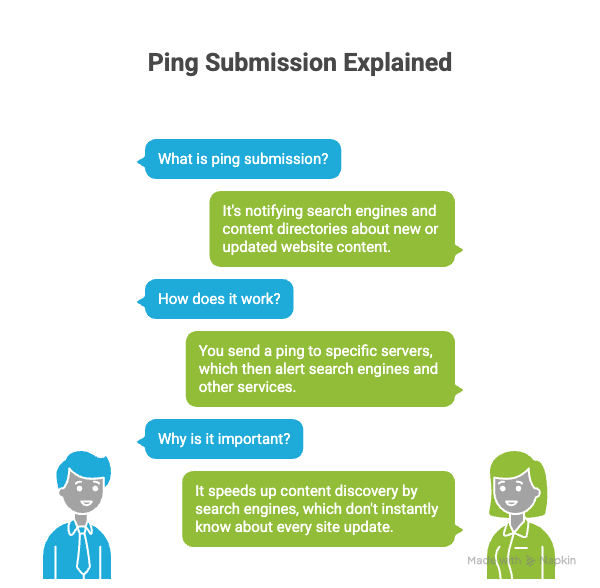
Ping submission is the process of notifying search engines and content directories that your website has published new content or updated existing pages.
When you publish a new blog post, you can send a signal called a ping to specific servers. These servers then alert search engines and other services that your site has fresh content.
In simple terms, ping submission is like raising your hand and saying, “I have something new.”
Search engines constantly crawl the web. However, they do not instantly know when every site updates. Ping services help speed up the discovery process.
How Ping Submission Works
When you publish a new post, your content management system can send a small notification message to a ping server. This message usually contains:
- Your website name
- The page URL
- The feed URL
- A short update notice
The ping server receives this information and updates its directory. Search engines monitor these directories and may send crawlers to review your updated page.
The main purpose is faster indexing.
However, ping submission does not guarantee ranking improvements. It simply improves the chances of quicker discovery.
Why Ping Submission Became Popular
In earlier stages of SEO, search engines relied more heavily on external signals to discover content. Many websites were not crawled frequently. Ping submission helped bloggers gain visibility faster.
It was particularly useful for:
- New websites
- Blogs with low authority
- Sites without strong backlink profiles
- Frequent content publishers
Over time, search engines became more advanced. Crawling systems improved. Major websites are now crawled frequently without manual pinging.
Still, ping submission remains relevant in certain cases.
Does Ping Submission Still Work In 2026
Yes, but with limitations.
Ping submission can still help:
- Notify aggregators
- Signal content updates
- Support faster discovery for new websites
However, it is no longer a powerful ranking tactic.
Search engines today prioritize content quality, engagement, and authority. Techniques such as advanced link building techniques play a much stronger role in determining rankings than simple discovery signals.
Ping submission supports indexing. It does not replace comprehensive SEO strategy.
Benefits Of Ping Submission
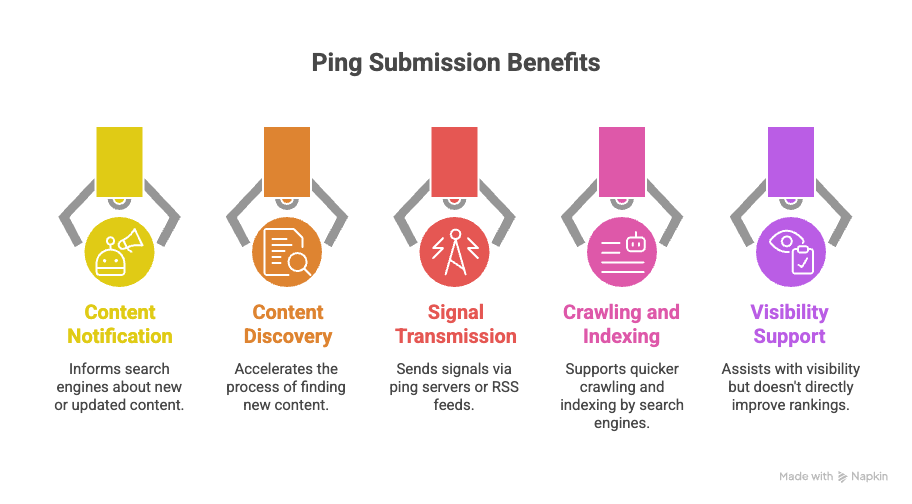
Faster Content Discovery
If your site does not have high crawl frequency, pinging can encourage search engines to revisit your content sooner.
Support For New Blogs
New websites often struggle with visibility. Ping submission can provide initial discovery signals before organic authority builds.
Indexing Updated Content
If you significantly update an article, pinging can help notify directories and encourage fresh crawling.
Low Effort Implementation
Most blogging platforms allow automatic ping submission. Once configured, it runs in the background.
Limitations Of Ping Submission
While ping submission has benefits, it also has limitations.
No Direct Ranking Boost
Ping submission does not improve keyword rankings by itself. It simply alerts search engines to new content.
Risk Of Overuse
Excessive pinging can appear spammy. If you send repeated pings without meaningful updates, it may reduce trust.
Limited Impact For High Authority Sites
Established websites are already crawled frequently. Ping submission may provide little additional value.
Cannot Replace Authority Signals
Modern search engines rely heavily on content depth, topical authority, and backlink profiles. Structured programmatic SEO strategies often deliver stronger and more sustainable results than simple ping notifications.
How To Do Ping Submission Properly
If you decide to use ping submission, follow a structured approach.
1. Enable Automatic Pinging
Most content management systems allow you to configure ping services in the settings panel. Add reputable ping servers only.
2. Ping Only When Publishing New Content
Avoid pinging repeatedly for minor changes. Only notify servers when meaningful updates occur.
3. Focus On Quality Updates
Before sending a ping, ensure your content offers real value. Thin content will not benefit from faster indexing.
4. Combine With Strong SEO Foundations
Ping submission works best when combined with technical SEO, internal linking, and authority building.
Even simplified site structures such as those optimized through SEO for single page websites can benefit from faster indexing when technical clarity is maintained.
Ping Submission And Indexing Speed
One of the most common questions is whether ping submission guarantees instant indexing.
The answer is no.
Ping submission increases the likelihood of faster crawling. It does not guarantee immediate indexing. Search engines still evaluate:
- Content quality
- Site authority
- Technical health
- Spam signals
If your content meets quality standards, pinging may reduce discovery time.
Common Ping Services
Several online ping services allow manual submission. These services distribute your content information to multiple directories at once.
However, manual submission is rarely necessary for modern websites. Automatic pinging through your content management system is usually sufficient.
Always avoid low quality bulk ping services that promise ranking improvements. That approach may harm credibility.
Ping Submission Versus Sitemap Submission
Ping submission and sitemap submission are different.
A sitemap is a structured file listing your site pages. It helps search engines understand your website architecture.
Ping submission is a notification signal.
Both support discovery, but sitemaps provide deeper structural clarity.
If your technical foundation is weak, consider improving overall site architecture through professional SEO services before relying on ping notifications alone.
Ping Submission And Blog Feeds
Ping services often use your RSS feed to detect updates. That is why maintaining a clean and functional feed is important.
Ensure your feed:
- Updates automatically
- Reflects accurate timestamps
- Includes correct URLs
Broken feeds reduce ping effectiveness.
Is Ping Submission Considered Black Hat
No, ping submission itself is not black hat.
However, abuse can create problems.
Repeatedly pinging without real updates or using automated spam tools can trigger negative signals.
Ethical implementation is key. SEO success depends more on trust and quality than shortcuts.
An integrated digital marketing strategy that combines content value, user engagement, and authority signals will always outperform mechanical tactics alone.
When Should You Use Ping Submission
Ping submission is not something you need to use daily. It is a supportive technique, not a primary SEO strategy. However, there are specific situations where ping submission can be useful and practical.
Understanding when to use it helps you avoid unnecessary actions and focus on meaningful updates.
1. When Launching A New Website
New websites often have low crawl frequency. Search engines may not visit them regularly in the beginning.
In this situation, ping submission can help notify search engines that new content has been published. It increases the chances of faster discovery and initial indexing.
While it will not improve rankings directly, it can shorten the time between publishing and being indexed.
2. When Publishing Time Sensitive Content
If you publish:
• Industry news
• Trend updates
• Event related articles
• Product announcements
Speed matters.
Ping submission can help alert search engines quickly so your content has a better chance of appearing while the topic is still relevant.
For time sensitive content, faster crawling can make a noticeable difference.
3. When Updating Cornerstone Articles
If you significantly update an important article by adding new sections, fresh data, or revised insights, ping submission can help signal that the page has changed.
This encourages search engines to recrawl and reevaluate the updated content.
However, this should only be done for meaningful updates, not minor edits.
4. When Your Site Has Low Crawl Frequency
Some niche websites or small blogs do not get crawled frequently due to limited authority or low publishing activity.
If your site falls into this category, ping submission may help increase crawl activity after publishing new posts.
You can check crawl frequency using Google Search Console to see how often search engines visit your pages.
5. When Starting A Blog On An Existing Website
If you add a blog section to an existing website that previously had only service pages, search engines may take time to recognize the new content structure.
Ping submission can help notify search engines about the new blog posts and encourage discovery.
6. After Major Site Changes
If you:
• Redesign your website
• Change URL structure
• Add a new content category
• Launch a new section
Ping submission can help alert search engines about these changes.
However, this should always be combined with proper sitemap updates and internal linking adjustments.
7. When Publishing Consistently But Crawling Is Slow
Some websites publish regularly but still experience slow indexing. In such cases, ping submission can act as a supplementary signal.
It should not replace proper technical SEO, but it can support faster discovery when used responsibly.
When You Do Not Need Ping Submission
It is equally important to understand when ping submission is unnecessary.
You generally do not need it if:
• Your site has high authority
• Your pages are indexed quickly already
• Search engines crawl your site frequently
• You use tools like URL inspection request in Search Console
Established websites are crawled regularly. Ping submission may add little value in these cases.
A Balanced Approach
Ping submission works best as part of a broader SEO strategy.
Use it:
• After publishing new content
• After meaningful updates
• When crawl frequency is low
Avoid using it repeatedly or automatically for minor changes.
Modern SEO success depends more on content quality, authority, and technical health than on notification signals alone.
Ping submission is helpful in specific situations, but it should always support a strong foundation rather than replace it.
Ping Submission And Content Strategy
Ping submission should not be viewed as a growth strategy. It is a supporting mechanism.
The real drivers of visibility include:
- Strong content depth
- Clear topical clusters
- Consistent publishing
- User engagement
- Authority development
Websites that rely on structured content expansion through programmatic SEO strategies tend to build stronger contextual relevance, which supports sustainable indexing and ranking performance.
Ping submission simply helps search engines discover those assets faster.
Best Practices For Modern SEO
Instead of focusing heavily on ping submission, consider the broader picture.
Create High Value Content
Search engines reward helpful content that solves real problems.
Build Authority Gradually
Backlinks from credible sources strengthen trust. Ethical authority building and advanced link building techniques remain essential for competitive industries.
Improve Technical Health
Fast loading pages, mobile optimization, and clean site architecture improve crawl efficiency.
Strengthen Internal Linking
Guide both users and search engines through your content with clear contextual links.
Monitor Indexing Status
Use Google Search Console to monitor coverage reports and identify crawling issues.
Ping submission supports this framework. It does not replace it.
Mistakes To Avoid while doing ping submission
Ping submission is simple, but many website owners misuse it. When used incorrectly, it can reduce credibility instead of helping with indexing. Below are the most common mistakes and why you should avoid them.
1. Repeated Pinging Without New Content
One of the biggest mistakes is sending multiple pings without publishing meaningful updates. Some site owners ping the same page several times in a short period.
Search engines may interpret this as spam behavior. Ping only when you publish a new article or make substantial content updates.
2. Using Automated Bulk Ping Tools
There are many tools that promise to submit your site to hundreds of ping services instantly. Most of these services are low quality or outdated.
Overusing bulk ping tools can create spam signals. It is better to rely on your content management system’s built in ping feature or a small list of trusted servers.
3. Expecting Ranking Improvements
Ping submission helps with content discovery, not ranking. Many beginners believe pinging will push their pages higher in search results.
Ranking depends on content quality, authority, backlinks, and user engagement. Ping submission simply helps search engines notice your page faster.
4. Ignoring Content Quality
If your content is thin or low value, faster indexing will not help. In fact, it may expose poor content to search engines more quickly.
Always focus on publishing useful, well structured, and informative content before sending a ping.
5. Pinging Minor Edits
Do not send a ping for small edits like fixing a typo or changing a single sentence. This adds unnecessary noise.
Only ping when there are meaningful updates such as adding new sections, updating statistics, or publishing new blog posts.
6. Forgetting Technical SEO Basics
Ping submission cannot fix technical problems. If your site has slow loading speed, broken internal links, or crawl errors, those issues must be resolved first.
A strong technical foundation supports proper indexing far more effectively than repeated pinging.
7. Using Outdated Or Suspicious Ping Services
Some ping directories no longer provide value. Others may be associated with spam networks.
Stick to reputable ping services and avoid unknown platforms that promise instant traffic or ranking boosts.
Ping submission is a supporting SEO technique, not a growth strategy. When used properly, it can help search engines discover your content faster. When abused, it can create unnecessary spam signals.
Focus on quality updates, responsible use, and strong overall SEO fundamentals.
The Role Of Ping Submission In 2026
In modern SEO, ping submission plays a minor but supportive role.
Search engines are highly advanced. Major websites are crawled frequently. Artificial intelligence systems evaluate content depth, authority, and engagement signals more heavily than discovery notifications.
However, for smaller sites or new blogs, ping submission remains a helpful supplementary step.
Think of it as knocking on the door rather than forcing it open.
Final Thoughts
Ping submission is a simple method used to notify search engines about new or updated content. It can support faster discovery, especially for new websites or blogs with low crawl frequency.
However, it is not a ranking strategy. It does not replace content depth, authority signals, or technical optimization.
Modern SEO requires a balanced approach.
Focus on:
- Publishing valuable content
- Building topical authority
- Strengthening backlink profiles
- Maintaining technical clarity
- Supporting discovery with tools like ping submission
When integrated thoughtfully into a broader optimization plan, ping submission can serve as a helpful supporting tool.
But long term success in search visibility will always depend on quality, trust, and user satisfaction.
If you approach SEO with that mindset, techniques like ping submission become part of a structured strategy rather than isolated tactics.













 in India